If you live outside the US and AdSense asks for "United States tax info", it wants to know whether to withhold US tax from your payments. As an individual you'll end up with Form W-8BEN, which the AdSense tax tool fills in from your answers. Google's rule for documented non-US publishers is that "only the portion of your revenue earned from US users is subject to US withholding taxes and reporting", and a treaty between your country and the US can reduce that. If you don't submit a valid form, Google says it "may apply backup withholding at 24% or chapter 3 withholding at 30% on applicable payments."
You'll find it under Payments > Payments info > Manage settings, then the edit icon next to United States tax info in the "Payments profile" section, then Manage tax info (submit your US tax info). Google adds: "Make sure you submit your tax information before the 20th to receive a payment in the same month."
This page explains what each step asks and what Google and the IRS say about it; for your own situation, ask a tax adviser.
Which form you'll get
You don't choose the form. "The appropriate tax form is automatically generated based on the answers you provide" (FAQs about US tax info). The ones that matter for most publishers:
- W-8BEN: "Generally, a Form W-8BEN or Form W-8BEN-E is required from individuals and entities (respectively) outside of the US who are the beneficial owner of the income received. It may be used to claim a treaty benefit (in other words, a reduced rate of withholding)."
- W-8BEN-E: the same for companies and other entities.
- W-9: "required from US persons, companies, partnerships, and so on." If you're a US citizen living abroad, this is yours, not the W-8BEN; the IRS instructions say a US citizen "should not complete this form even if you hold citizenship in another jurisdiction. Instead, provide Form W-9."
Google's distinction: "An individual account is owned and operated by an individual person and not a legal organization." A non-individual account "is a business account that's separate from its owner for tax purposes." If you run the site yourself under a personal payments profile, you're almost certainly the first. If you've registered a business and aren't sure which side it falls on, settle that with an adviser before you sign.
What the form asks, part by part
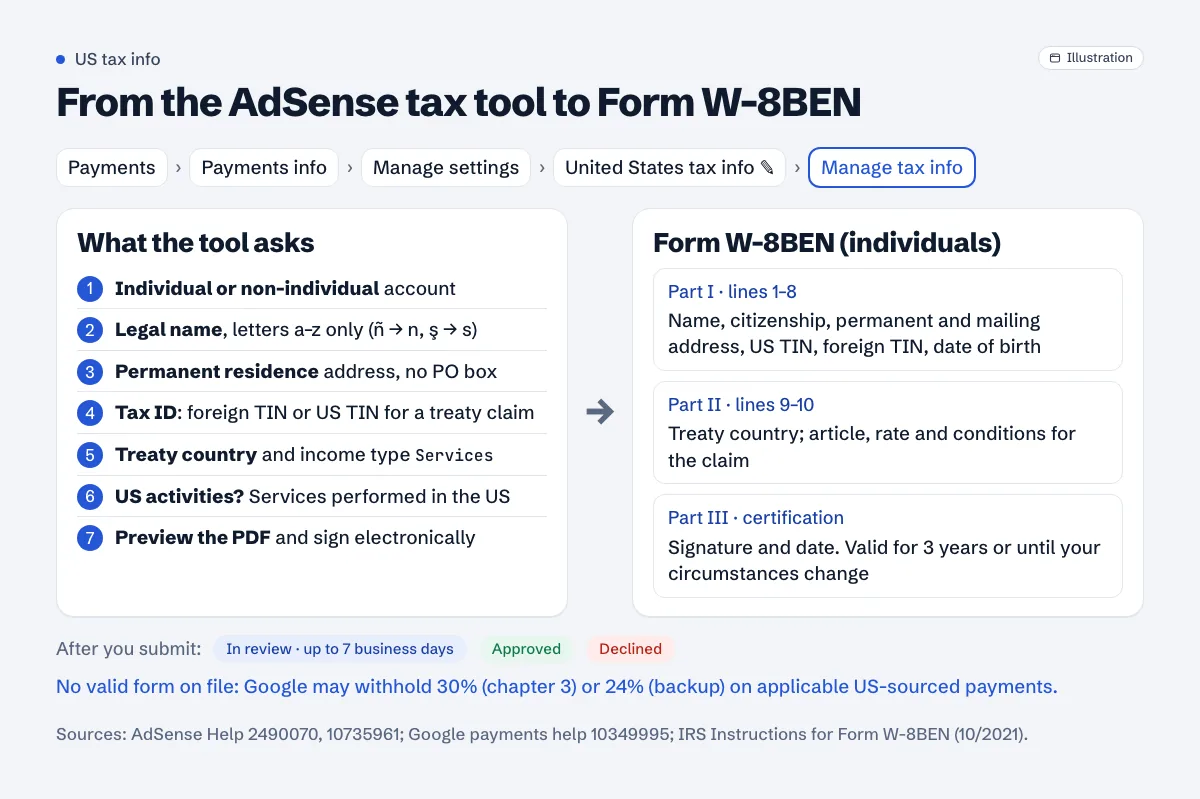
Name and type of account
Individual or non-individual first, then your legal name "exactly as it appears on your legal documents". One rule catches a lot of non-English names: the fields "only support upper- or lower-case letters (a–z, A–Z), numbers (0–9), spaces, hyphens (-), and ampersands (&)" because of IRS reporting requirements (US tax reporting & withholding). Google's advice: "use the letter equivalent, such as n for ñ or a for á", and where possible copy the spelling from a passport.
Then match it to your AdSense payments profile. A name that differs between the two is the first item on Google's list of things that send W-8 forms to manual review.
Addresses
Your permanent residence address is the address in your country of tax residence. The IRS instructions: "Do not show the address of a financial institution, a post office box, or an address used solely for mailing purposes." Google adds that a PO box or "in care of" address may require extra documents, and that a US address on a non-US form needs "additional information to support the fact that you're not a US person."
Tax identification number
Here's where people get stuck. Google says "If you are claiming a tax treaty benefit, you are required to provide either a Foreign TIN or a U.S. TIN." A foreign TIN is the tax number your own country issues. You don't need a US ITIN to claim a treaty rate if you give your foreign TIN, and the IRS notes an ITIN "usually takes 4–6 weeks" to get.
Treaty benefits
You pick your country of tax residence and the income types. Google explains the choice: AdSense falls under "Services or other business income (such as AdSense, but not including AdSense for YouTube)". YouTube earnings are royalties and a different line. "If your country and the United States have an income tax treaty in place, then the tax tool in AdSense will identify the details of that during tax form submission."
US activities
The tool asks whether you have activities in the US. Google defines them as "the performance of a service in the United States. This can include having employees or owning equipment in the US that are involved in generating revenue." If you run your site from outside the US, with no staff or equipment there, that usually means no; renting a server in a US data centre is something to raise with your adviser rather than guess.
Preview, sign, and wait for review
"Google will generate PDFs of the IRS tax forms that were filled out. You'll be required to verify the accuracy of your documents." Read the PDF; it's what the IRS rules apply to. After you sign, the status is In review ("This may take up to 7 business days"), then Approved or Declined. Google lists the decline reasons: a TIN that "couldn't be found in IRS records", a "TIN and name combination" that doesn't match, or information that "can't be validated with the documents you provided."
Claiming a treaty rate, carefully
Three facts, then one rule.
The IRS keeps the list of US income tax treaties. Google can't decide your eligibility: "Google can't make this determination for you." And the AdSense tool proposes the treaty details itself when you choose your country.
For a business-profits claim, the W-8BEN instructions ask for something specific on line 10: "Complete line 10 by stating that you derive business profits or gains (other than from real property) not attributable to a permanent establishment. You must also include the relevant treaty article."
Turkey, as an example. There is a US-Turkey income tax treaty; the IRS Turkey treaty page links the text, which gives a general effective date of 1 January 1998. Its Article 7 (Business Profits), paragraph 1, reads: "The profits of an enterprise of a Contracting State shall be taxable only in that State unless the enterprise carries on business in the other Contracting State through a permanent establishment situated therein." Article 14 covers independent personal services. Which article fits your AdSense income, and whether you meet its conditions, is a judgement about your own facts. We'd let the tool propose the article and rate, compare it with the treaty text, and ask an adviser if the two don't line up, rather than typing an article number from a forum post.
The rule: don't claim a treaty benefit you can't explain. You sign the form as a certification of what's on it, and a wrong claim is worse than no claim.
What happens if you skip it
Google is clear about the default: "If a valid tax form isn't provided, the default withholding rate is generally 30% on applicable payments." In some cases it's 24% backup withholding "where an undocumented partner is presumed US." Even if you don't want a treaty rate, Google says "to comply with IRS rules and requirements, Google must collect proof that you're a non-US person."
What gets withheld is the US-sourced part. For a documented non-US publisher, "only the portion of your revenue earned from US users is subject to US withholding taxes." If most of your readers are outside the US, that's a small share of your earnings. Without a valid form, though, the default rates are what Google applies to that share.
You'll see the amount in your monthly earnings report, and your rates in the payments profile "under Settings Manage tax info". If you had tax withheld and later submit a valid W-8 with a lower rate, Google describes an "affidavit of unchanged status" that can be used for a refund of that year's withholding, claimed "by December 31 of the year in which withholding occurs."
Mistakes worth avoiding
- Typing the name with local characters. Write it as in your passport, letters a-z only.
- A name that differs from the payments profile. It sends the form to review. If you change your payments name later, Google says "you also need to resubmit your tax information" (change payments name or address).
- Choosing "entity" for a personal account, or the reverse.
- Ticking US activities because your host is American. Read Google's definition first.
- Forgetting it expires. "The IRS requires Google to refresh its non-US partners and vendors tax forms at the earlier of (1) every 3 years or (2) If there has been a change in circumstances."
- Submitting on the 21st. Holds cleared after the 20th move your payment to the next month.
This form deals only with US withholding. Tax in your own country on what AdSense pays you is a separate matter.
The site side, while you're here
Tax info is one of several setup steps; the approval time guide shows where it sits, and the PIN guide covers address verification. A free Approvalens scan checks the site itself before or after approval: scan your site.
FAQ
Do I have to submit US tax info if I'm not in the US?
If AdSense asks for it, yes. Not every publisher is asked, but Google says it needs proof you're a non-US person, and without a valid form default withholding can apply.
Will Google withhold 30% of all my earnings?
Not of everything. For a documented non-US publisher, only revenue from US users is subject to US withholding. The 30% default applies to applicable payments when no valid form is on file.
Do I need a US ITIN?
Not usually, if you claim a treaty benefit with the tax number from your own country. Google accepts "either a Foreign TIN or a U.S. TIN" for treaty claims.
Is the W-8BEN valid forever?
No. Google refreshes non-US forms every three years or sooner if your circumstances change.
Can Google tell me if I qualify for a treaty?
No. Google says it can't make that determination and points you to the IRS and a tax adviser.
Spotted something out of date or wrong? Tell us and we'll correct it.
Read this guide in Turkish →Free scan
Check your own site
The free scan reads the first 50 pages and shows your score and every problem it finds.