On this page (9)
- 01What Google actually says about title length
- 02Why pixels and not characters
- 03Where "600 pixels" comes from
- 04Google may not use your title at all
- 05How to write titles that survive the cut
- 06Meta descriptions follow the same rule
- 07How Approvalens counts length
- 08Check your titles before you publish
- 09FAQ
There is no maximum title length in Google. Google's own documentation says so, and it says the title link is shortened to fit the screen it's shown on. So the useful limit is a width, not a character count. On desktop, titles are commonly observed to cut off at around 600 pixels, which in the font Google uses there is roughly 50 to 65 characters depending on the letters. Put the words that matter first, keep most titles under about 55 characters, and preview anything longer.
What Google actually says about title length
From Google's title link documentation: "While there's no limit on how long a <title> element can be, the title link is truncated in Google Search results as needed, typically to fit the device width."
The sentence before it is the practical part: "Also avoid unnecessarily long or verbose text in your <title> elements."
That's the whole official position. Google doesn't publish a character count, a pixel count or a different number for mobile. Every number you've read elsewhere, including the ones in this guide, comes from measuring what the results page does today.
Why pixels and not characters
A results page cuts text when it runs out of horizontal space. Letters have different widths, so the same number of characters can take very different amounts of space.
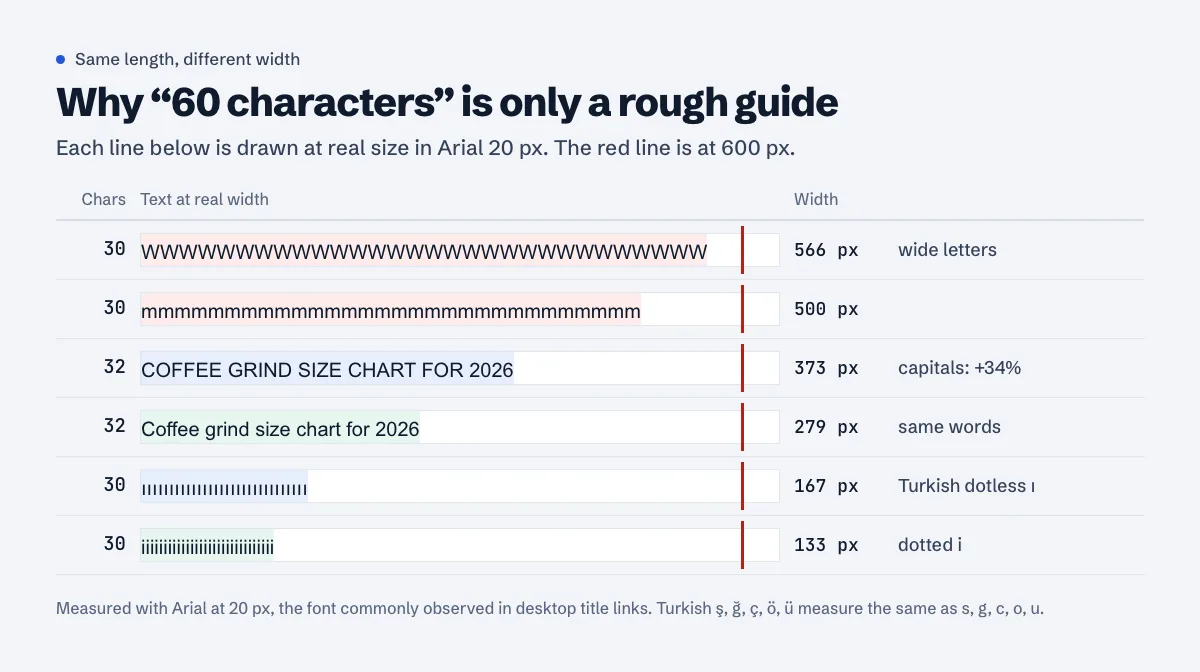
We measured these in Arial at 20 px, the font and size commonly seen for desktop title links (again an observation, not something Google documents). What stands out:
- Capitals cost a lot. "COFFEE GRIND SIZE CHART FOR 2026" is 373 px; the same words in lowercase are 279 px. Title Case sits in between.
- Wide letters add up. W and m are four times the width of i and l. A title full of "www", "Mm" or numbers runs out of room sooner.
- Turkish letters with marks are not wider. ş, ğ, ç, ö and ü measure exactly the same as s, g, c, o and u. The one difference is the dotless ı, which is wider than the dotted i (5.56 px against 4.44 px). Turkish titles get cut earlier mainly because Turkish words are longer, not because of the special letters.
Where "600 pixels" comes from
The figure is how wide the title area on a desktop results page has commonly been measured. It isn't a rule, it changes when Google changes its layout, and phones are different: Google's wording, "to fit the device width", means the cut point moves with the screen.
Here is what it looks like on two versions of the same page title:
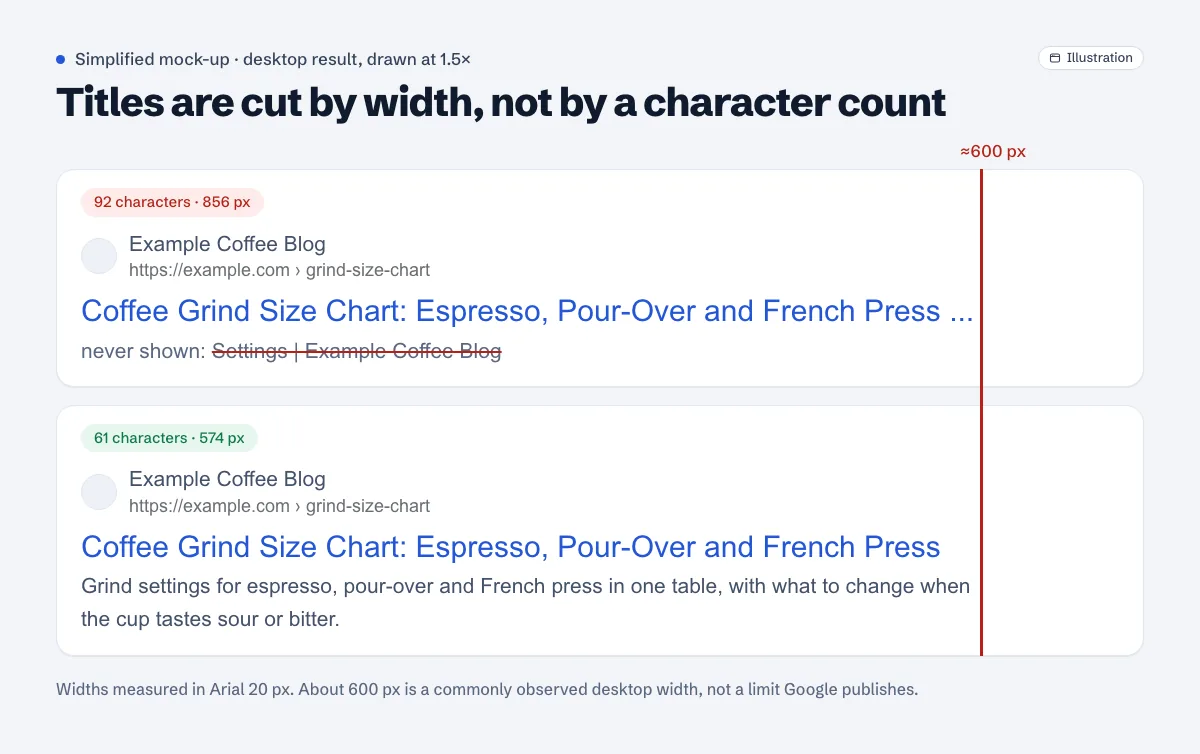
The free SERP snippet preview does this measurement in your browser: paste a title and description and it draws them at that width, with the cut where it would fall.
Google may not use your title at all
Length is not the main reason a title gets replaced. Google builds title links from several sources: the <title> element, the "Main visual title shown on the page", heading elements such as <h1>, og:title, other large and prominent text, anchor text, links pointing to the page and WebSite structured data. Its generation "is completely automated".
The documentation lists the cases where it most often writes its own:
- Half-empty titles such as
<title>| Site Name</title>. - Obsolete titles, for example last year's date when the page says this year.
- Inaccurate titles that don't match what the page is about.
- Micro-boilerplate, where many pages share one title and only the page content tells them apart.
- No clear main title, when several headings look equally prominent.
- Language or script mismatch between the title and the page.
- The site name repeated: "Google may omit the site name from the title link, if it's repetitive with the site name that's already shown in the search result."
That last one matters for length. The site name already appears above the title on the result, so a long " | Example Coffee Blog" suffix is often the first thing to go, either cut off or dropped by Google. For more on boilerplate and duplicate titles, see duplicate titles and meta descriptions.
Google adds that changes are picked up only after it recrawls the page, "which may take a few days to a few weeks."
How to write titles that survive the cut
Lead with the subject. If the title is cut, the front survives. "Coffee Grind Size Chart: ..." still tells the reader what the page is.
Brand last and short, or not at all on articles. Google's example is ExampleSocialSite: Sign up for a new account., with the site name at one end, "separated from the rest of the text with a delimiter such as a hyphen, colon, or pipe".
Cut filler words before facts. "The Ultimate Complete Guide to" costs about 290 px, half the line, and tells the reader nothing.
Match the page. Keep the title close to the H1. A mismatch is one of the reasons Google rewrites; H1 and heading structure covers how the two should relate.
Watch capitals and numbers. All-caps words and long numbers eat width fast.
Don't pad short titles. A clear 35-character title is fine. "Home" is not: Google's docs ask you to avoid "vague descriptors like 'Home' for your home page".
| Before | Width | After | Width |
|---|---|---|---|
| Example Coffee Blog | Coffee Grind Size Chart for Espresso, Pour-Over and French Press | 801 px, cut after "Espresso" | Coffee Grind Size Chart: Espresso, Pour-Over, French Press | 540 px |
| The Ultimate Complete Guide to Descaling Your Espresso Machine Step by Step in 2026 | 788 px, cut after "Espresso" | How to Descale an Espresso Machine, Step by Step | 464 px |
| Home | 53 px | Example Coffee Blog: Brewing Guides and Grinder Reviews | 532 px |
Widths in Arial 20 px, cut at 600 px, measured the way the SERP preview tool does it.
Meta descriptions follow the same rule
The snippet documentation uses almost the same sentence: "There's no limit on how long a meta description can be, but the snippet is truncated in Google Search results as needed, typically to fit the device width."
Two differences from titles:
- Google often doesn't use your description. "Snippets are primarily created from the page content itself." Google uses the meta description "if it might give users a more accurate description of the page than content taken directly from the page", and it "might show different snippets for different searches."
- The space is larger and wraps. On desktop, snippets are commonly observed to run to roughly 155 to 160 characters before the ellipsis. Our preview tool uses about 920 px at 14 px Arial. Neither is a Google number.
If you want to cap snippet length, Google supports the max-snippet:[number] robots meta rule. Most small sites have no reason to use it.
Write one or two sentences that sum up the page and include something specific (a number, a step, a price, what's in the table). Unique per page matters more than exact length.
How Approvalens counts length
Our checks use characters, because they run on many pages at once, and treat length as a readability hint:
- Site level: a notice when 20% or more of your home page and articles have titles over 60 or under 25 characters, or descriptions over 160 or under 70.
- Page level: a page is flagged when its title is over 70 or under 15 characters, or its description is under 50 or over 170.
A flag isn't a ranking problem by itself. It means it's worth previewing that title in pixels.
Check your titles before you publish
Paste a title and description into the free SERP snippet preview to see where the cut falls, or run a free scan to list every page with a title or description outside those ranges.
FAQ
How many characters can a title tag have?
As many as you like; Google sets no limit. What shows is limited by width. Around 50 to 60 characters usually fits on desktop, but capitals and wide letters can push a 55-character title past the edge.
Does a long title hurt rankings?
Google doesn't say that it does. It says to avoid "unnecessarily long or verbose" titles and that long ones are truncated. The practical cost is a cut-off title that's harder to read.
Why does Google show a different title from mine?
It builds title links automatically from your <title>, headings, og:title, anchor text and more, and replaces titles it finds half-empty, outdated, inaccurate or repetitive. Fix those issues and keep the title close to the H1.
Is 600 pixels the limit on mobile too?
No published limit exists for either. "To fit the device width" means the cut point depends on the screen, so keep the important words at the start.
Do Turkish characters make titles longer?
Not the marked letters: ş, ğ, ç, ö, ü are as wide as s, g, c, o, u. The dotless ı is slightly wider than i. Turkish titles run long mostly because the words are long.
Spotted something out of date or wrong? Tell us and we'll correct it.
Read this guide in Turkish →Check it on your own site. Free, no sign-up.
Free tools for this
Free scan
Check your own site
The free scan reads the first 50 pages and shows your score and every problem it finds.