You can run affiliate links and AdSense on the same site. Nothing in the AdSense policies forbids it, and plenty of approved review sites do both. What gets affiliate sites rejected is the page type Google calls thin affiliation: product text copied from the store, a row of "check price" buttons, nothing the reader couldn't get on the seller's own page. The second problem is quieter: affiliate links nobody told the reader about.
Fix those two and an affiliate site is reviewed like any other content site.
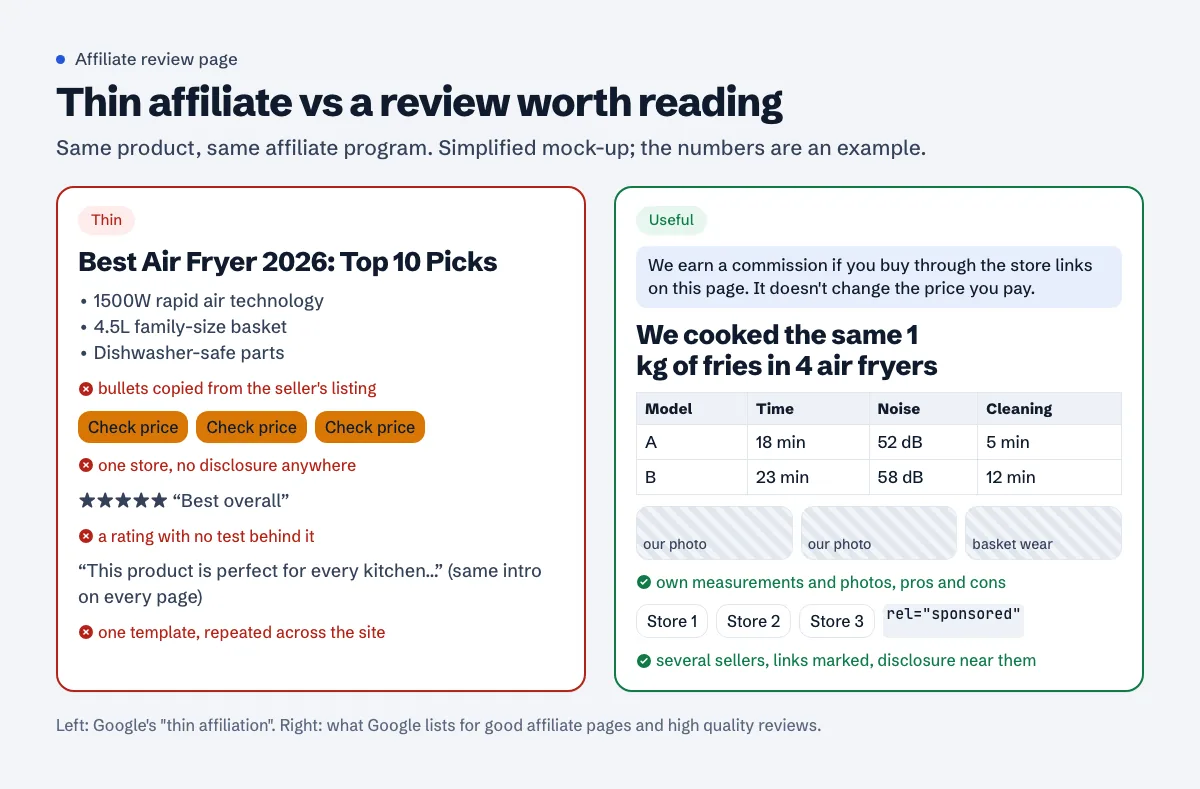
What Google calls "thin affiliation"
Google Search's spam policies define it in one sentence: "Thin affiliation is the practice of publishing content with product affiliate links where the product descriptions and reviews are copied directly from the original merchant without any original content or added value."
The same section names the shape these sites take: "These sites often appear to be cookie-cutter sites or templates with the same or similar content replicated within the same site or across multiple domains or languages."
AdSense uses the same idea. Its beginner's guide to AdSense policies tells publishers: "Don't create "doorway" pages created just for search engines, or other "cookie cutter" approaches such as affiliate programs with little or no original content." When a site is mostly pages like that, the rejection usually arrives as "Low value content", which our low value content guide walks through.
Affiliate links themselves are not the problem
Google is clear on this from several directions:
- The spam policy continues: "Not every site that participates in an affiliate program is a thin affiliate. Good affiliate sites add value by offering meaningful content or features."
- On paid links: "Google does understand that buying and selling links is a normal part of the economy of the web for advertising and sponsorship purposes. It's not a violation of our policies to have such links as long as they are qualified with a rel="nofollow" or rel="sponsored" attribute value."
- Among the things that are not site reputation abuse, Google lists "Using affiliate links throughout a page, with links treated appropriately".
So the question a reviewer is answering isn't "are there affiliate links?" It's "is there a reason to read this page instead of the store page?"
What adds value on a review page
Google lists what good affiliate pages offer: "additional information about price, original product reviews, rigorous testing and ratings, navigation of products or categories, and product comparisons." Its high quality reviews guidance goes further. The points that change a page the most:
- Evidence you used the thing. "Provide evidence such as visuals, audio, or other links of your own experience with what you are reviewing." Your own photos, including the scuffed and boring ones, do more than any stock image.
- Numbers you measured. "Share quantitative measurements about how something measures up in various categories of performance." Battery hours, minutes to boil, decibels, weight on your kitchen scale.
- Downsides. "Discuss the benefits and drawbacks of something, based on your own original research." A review with no cons reads like an ad, because it is one.
- Comparison and fit. "Explain what sets something apart from its competitors" and "Cover comparable things to consider, or explain which might be best for certain uses or circumstances."
- More than one store. "Consider including links to multiple sellers to give the reader the option to purchase from their merchant of choice."
- Reasons behind "best". "When recommending something as the best overall or the best for a certain purpose, include why you consider it the best, with first-hand supporting evidence."
Google also says what doesn't count: focus on "the quality and originality of your reviews, not the length." Padding a copied spec sheet to 2,000 words with generic buying advice doesn't make it a review.
The reviews system page describes what Search is trying to reward: "reviews that share in-depth research, rather than thin content that simply summarizes a bunch of products." That page also notes the system can look beyond single pages: "for sites that have a substantial amount of review content, any content within a site might be evaluated."
If you can't test the product
Not every affiliate site can buy every product. That's fine, as long as the page says what it is. A comparison built from published specs, with a clear method ("we compared the manufacturer's stated capacity, warranty length and the price on three stores on 7 October 2026"), is honest and useful. What isn't honest is writing "we tested" when you didn't, or a five-star rating with no basis.
Disclosing affiliate links
Two separate reasons to do it, and they overlap.
Google's side. The Publisher Policies don't allow content that "misrepresents, misstates, or conceals information about the publisher, the content creator, the purpose of the content, or the content itself" (misleading representation). Google doesn't name affiliate links there, but a page built to earn commissions and presented as a neutral review sits uncomfortably close to "conceals ... the purpose of the content". On the link level, Google asks you to "Mark links that are advertisements or paid placements (commonly called paid links) with the sponsored value" (qualify outbound links):
<a href="https://store.example.com/p/123?tag=yourid-20" rel="sponsored">See it at Store 1</a>
The law's side. It depends on where you and your readers are, and we won't give legal advice. As one example of how a regulator thinks about it, the US Federal Trade Commission's Endorsement Guides Q&A says: "You should disclose your relationship to the retailer clearly and conspicuously on your site, so readers can decide how much weight to give your endorsement." It also says "affiliate link" on its own may not be understood by readers, while "'Paid link' right next to an affiliate link should be an adequate disclosure." Check the consumer protection authority in your own country; the rules and the wording they expect differ.
What a workable disclosure looks like in practice:
- One plain sentence before the first affiliate link on the page: "We earn a commission if you buy through links on this page. It doesn't change the price you pay."
- A short label next to buttons where the page is long ("paid link", "affiliate link: we earn a commission").
- A disclosure page linked from the footer that explains which programs you're in and how you choose products.
rel="sponsored"on every affiliate link, including the ones inside images and buttons.
A footer-only disclosure on a page where the buttons are 3,000 words above it doesn't do the job.
Keep your own buttons distinct from Google's ads
Affiliate sites often style product boxes to look like ads, or put "Buy now" boxes right against ad units. The AdSense Program policies don't allow publishers to "Format site content so that it is difficult to distinguish it from ads" or to "Place misleading labels above Google ad units." Give your product boxes their own look, keep some space between them and ad units, and don't label an ad slot "Top deals". Our accidental clicks guide covers spacing in more detail.
The site as a whole, before you apply
Reviewers look at the site, not one page. A pattern we'd fix before applying:
- Mostly short product pages. If most articles are under a few hundred words and each one exists to send a click, the site reads as a link list. Merge thin single-product pages into one solid comparison, or expand the ones you can actually review.
- Only commercial pages. Add content with no affiliate link at all: how-to guides, care and repair, buying advice that ends in "you probably don't need to buy anything". It shows the site exists for readers. The thin content guide has a triage method.
- Same template everywhere. Identical intros, identical "Top 10" structures and identical FAQ blocks across hundreds of pages are what "cookie-cutter" means. See duplicate content and AdSense.
- No people. A review needs a reviewer. A name, an author page and a short "how we test" page go a long way; the author pages guide shows what to include.
- Money topics. Credit cards, loans and insurance affiliates are YMYL. The bar is higher; read YMYL sites and AdSense.
Check your affiliate pages
A free Approvalens scan counts the articles carrying affiliate links, flags a site that's mostly short affiliate pages and checks whether the links are disclosed: scan your site.
FAQ
Can I use Amazon affiliate links and AdSense on the same page?
AdSense doesn't forbid it. Follow the affiliate program's own rules too, keep your product boxes visually distinct from ads, and disclose the links.
Do I need rel="sponsored" on affiliate links for AdSense approval?
Google doesn't list it as an AdSense requirement. It's what Google Search asks for paid links, and rel="nofollow" is also acceptable. It costs nothing to add, so we'd add it.
Will a site with only "best X" lists get approved?
Lists can work when each entry has a reason behind it. Google says to "Ensure there is enough useful content in your ranked lists for them to stand on their own." Ten products with copied specs and the same verdict won't.
Should I remove affiliate links before applying, then add them back?
We wouldn't. The reviewer should see the site you'll actually run, and the same policies apply after approval. Fix the thin pages instead.
Is a disclosure page in the footer enough?
Usually not on its own. Put a short disclosure on each page before the first affiliate link, and keep the footer page as the full explanation.
Spotted something out of date or wrong? Tell us and we'll correct it.
Read this guide in Turkish →Free scan
Check your own site
The free scan reads the first 50 pages and shows your score and every problem it finds.