There is no separate AdSense rulebook for health, finance or legal sites. You apply the same way and the same policies apply. What changes is how much a page on those topics has to prove. Google's own guidelines hold "Your Money or Your Life" pages to a higher standard, so an anonymous article with no sources that would pass on a hobby blog looks risky on a site about loans, medication or tax.
The fix is rarely more content. It's making the content checkable: who wrote it, where the facts come from, when it was last checked, and what the reader should do when the page isn't enough.
What YMYL means, in Google's words
The term comes from the Search Quality Rater Guidelines, the handbook Google's human raters use. Section 2.3 (September 11, 2025 edition) defines it like this:
"Some topics have a high risk of harm because content about these topics could significantly impact the health, financial stability, or safety of people, or the welfare or well-being of society. We call these topics "Your Money or Your Life" or YMYL."
It then splits the harm into types: "YMYL Health or Safety", "YMYL Financial Security" (topics that "could damage a person's ability to support themselves and their families"), "YMYL Government, Civics & Society" and "YMYL Other".
Google Search's helpful content page says what happens with that label on the ranking side: "our systems give even more weight to content that aligns with strong E-E-A-T for topics that could significantly impact the health, financial stability, or safety of people, or the welfare or well-being of society." The same page adds that for YMYL topics "the content must be highly accurate and consistent with established expert consensus."
Two things people get wrong. First, YMYL is about the topic of a page, not the niche of a site. A cooking blog with one post on diabetic meal plans has one YMYL page. Second, it's a scale. The guidelines say "it may be helpful to think of topics as clear YMYL, definitely not YMYL or something in between."
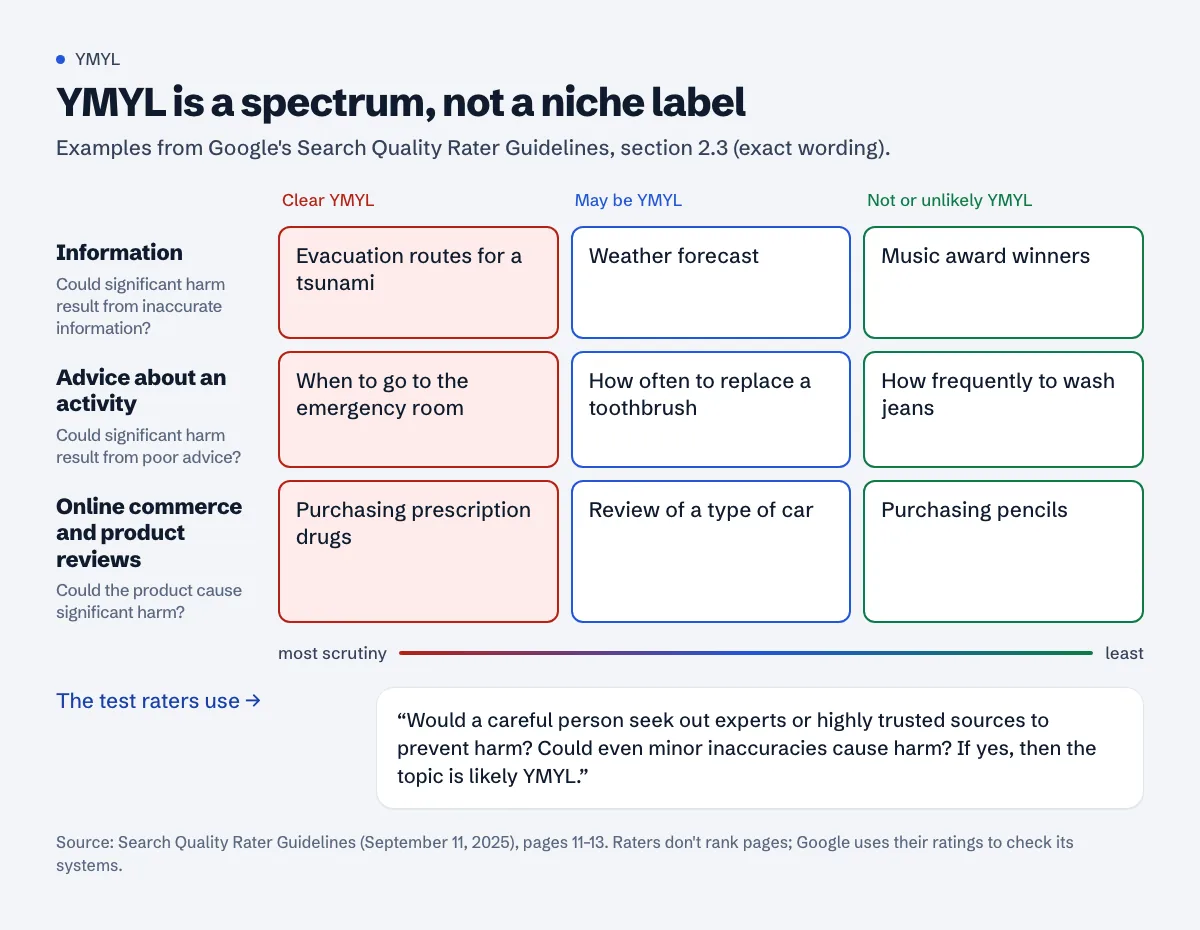
The quick test from the guidelines is worth keeping on a sticky note: "Would a careful person seek out experts or highly trusted sources to prevent harm? Could even minor inaccuracies cause harm? If yes, then the topic is likely YMYL."
Does AdSense have special rules for YMYL sites?
No published ones. Google doesn't list YMYL as an AdSense requirement, and raters are not AdSense reviewers. Google is explicit that "Rater data is not used directly in our ranking algorithms", and none of the AdSense help pages mention the rater guidelines.
So why care? Because the AdSense review is also a human or system looking at your site and deciding whether it's trustworthy enough to carry ads, and several Publisher Policies land squarely on health and money content. From the Google Publisher Policies:
- Unreliable and harmful claims. Google doesn't allow content that "promotes harmful health claims, or relates to a current, major health crisis and contradicts authoritative scientific consensus." The examples include "Anti-vaccine advocacy".
- Deceptive practices. No "promoting content, products, or services using false, dishonest, or deceptive claims." The example Google gives is "Get Rich Quick" schemes, which is exactly where thin finance blogs drift.
- Misleading representation. No content that "misrepresents, misstates, or conceals information about the publisher, the content creator, the purpose of the content, or the content itself" (policy page). An invented doctor is a textbook case.
Then there are the Publisher Restrictions: prescription drugs ("Sale of prescription drugs, online pharmacies"), unapproved pharmaceuticals and supplements, online gambling. Those don't block ads, but fewer advertisers bid. Writing about a medicine is different from selling it; our restricted content guide covers that line in detail.
Why YMYL pages get a harder look
The rater guidelines don't hide it. "For pages about clear YMYL topics, we have very high Page Quality rating standards because low quality pages on such topics could potentially negatively impact a person's health, financial stability, or safety, or the welfare or well-being of society."
The specific failure modes they name are useful, because they're the same things a reviewer can spot in a minute:
- Nobody is accountable. Section 5.5: "Pages on YMYL topics and other pages that require a high level of user trust should receive a Low rating if there is an unsatisfying amount of information about who is responsible for the website or who created the content."
- Nothing at all about the site. Section 4.5.1: "YMYL pages or websites that handle sensitive data with absolutely no information about the website or content creator should be rated Lowest."
- Clearly inexpert advice. Section 4.5.2: "If a page on YMYL topics is highly inexpert, it should be considered Untrustworthy and rated Lowest."
- Money pages without support. "Pages that offer payment functionality or process other types of financial transactions should receive a Low rating if there is an unsatisfying amount of customer service information or contact information."
If you read the page quality explainer, you'll recognise the scale. The YMYL part is where the bar moves.
What to show on a YMYL page
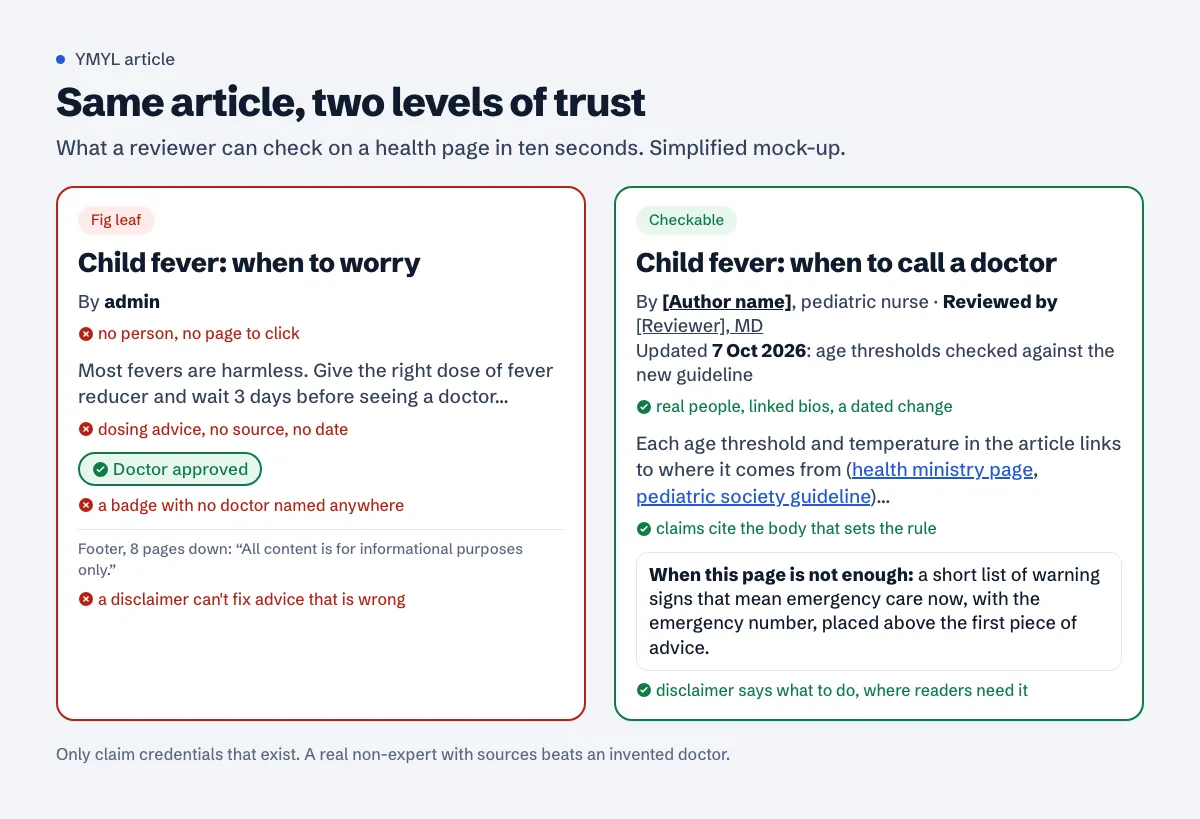
Here's the same article twice. Everything on the right is something a reviewer can click and check.
A real author, and credentials only if they exist
Google's helpful content page asks: "Is it self-evident to your visitors who authored your content?" and "Do bylines lead to further information about the author or authors involved?" Put a name near the title and link it to an author page that says what this person knows and how.
Then be careful. The same page now warns that "Fabricating creator profiles (such as by using AI-generated headshots, made-up names, or false credentials to make content appear as if it was written by human experts) is a form of deception." If you're a finance blogger without a licence, say what you are: someone who has done their own taxes for ten years and reads the regulator's guidance. That's honest experience. A fake "certified financial planner" is a policy problem. The author pages guide covers what a good author page contains.
If a qualified person really reviews your medical or legal articles, name them, link their public profile (a professional register, a clinic page) and say what they checked. "Medically reviewed" with no name behind it is worse than nothing.
Experience is allowed, within limits
Small sites often assume only doctors may write about health. The guidelines say otherwise, in section 3.4.1: "Pages that share first-hand life experience on clear YMYL topics may be considered to have high E-E-A-T as long as the content is trustworthy, safe, and consistent with well-established expert consensus. In contrast, some types of YMYL information and advice must come from experts."
Their examples draw the line well. "Safe and non-medical tips and tricks for sleeping in the last trimester of pregnancy, provided by people who have personally struggled with this challenge" is valuable experience. "Sleep medications that are safe during pregnancy" is best left to experts. "Reviews of retirement saving services by people with first-hand experience" is fine; "Advice on how to invest for retirement" is expert territory.
A practical reading: write about what happened to you, and source everything that tells the reader what to do.
Sources next to the claim
Link the primary source where the claim is, not in a list at the bottom. For health: the health ministry, the national public health agency, a specialist society's guideline, the medicine's approved leaflet. For money: the central bank, the tax authority, the bank's own rate page, the regulator. For legal topics: the law text and the official guidance.
A source is only as good as its match to your sentence. If you write "the limit is 5,000" and link a page that says something else, a reviewer who clicks has just found a reason to distrust the whole site.
Dates that mean something
Google's byline date documentation asks you to "Add a user-visible date to the page and feature it prominently" with labels like "Published" or "Last updated". On YMYL pages add one more thing: what changed. "Updated 7 October 2026: new tax brackets for 2027" tells the reader the check happened. A date that changes every week while the text doesn't is the opposite of trust.
Rates, limits, fees and dosages go stale. Keep a list of the pages that contain numbers like that and recheck them on a schedule.
Disclaimers that aren't fig leaves
"For informational purposes only" in a footer doesn't make bad advice safe, and nobody reads it. A useful disclaimer is specific and sits where the risk is:
- On a symptom article: the signs that mean urgent care, with the emergency number, above the first piece of advice.
- On a loan or investment article: that you're not licensed (if you aren't), that terms change, and where to check the current terms.
- On a legal article: which country the law applies to and the date of the law text you read.
Who runs the site
An About page that names the person or company, a working contact address, and for anything that takes payments or personal data, real customer service details. The rater guidelines say "Any site that handles personal, private or sensitive data must provide extensive contact information." Our About and contact pages guide has examples.
Pages that sink a YMYL site in review
These are the patterns we'd remove or rewrite before applying:
- Dosage tables or drug interaction lists copied from leaflets with no source and no date.
- "Cure", "guaranteed", "no risk", "approved in minutes" in titles. That's the wording the deceptive practices policy targets.
- Loan, card or insurance pages that are really affiliate offers, with no disclosure. See affiliate sites and AdSense.
- Calculators (loan, BMI, pregnancy due date) that don't say what formula they use or where the inputs come from.
- Dozens of AI-written symptom pages published in a week. Google's concern is scaled, unreviewed pages (our AI content guide quotes the policy), and on YMYL topics they're the riskiest kind.
- An author persona with a stock photo and a degree nobody can verify.
If a few pages are borderline and you can't source them properly, unpublish them before the review. Fewer, checkable pages beat more, doubtful ones.
A YMYL pass before you apply
- Every article that gives advice has a named author linked to a real bio
- Every credential mentioned is real and checkable
- Each number (rate, limit, dose, deadline) links to the official page it comes from
- Each YMYL article shows a "last updated" date and what changed
- Disclaimers are specific and placed above the advice, not only in the footer
- About page names who runs the site; contact page works
- No "guaranteed", "cure" or "risk-free" claims in titles or ads copy
- Affiliate links are disclosed next to the links
- Thin or unsourced pages are improved or unpublished
Check the trust signals on your own site
A free Approvalens scan flags a sensitive main topic, articles with no author name, and sensitive pages that cite no reliable source: scan your site.
FAQ
Can a health or finance blog get AdSense approval?
Yes. Nothing in the AdSense policies bans these topics. Sites get rejected for the usual reasons (thin content, missing pages, policy issues), and on YMYL topics weak trust signals make those reasons easier to trigger.
Do I need to be a doctor or a licensed adviser?
No. The rater guidelines value first-hand experience on YMYL topics as long as it is "trustworthy, safe, and consistent with well-established expert consensus." What you shouldn't do is give expert-level instructions (doses, investment allocations, legal strategy) without an expert or an official source behind them.
Is a medical disclaimer required for AdSense?
Google doesn't publish such a requirement. A disclaimer still helps readers when it's specific and well placed; a generic footer line does little for anyone.
Will my ads earn less on YMYL pages?
Google doesn't publish rates by topic. Some sub-topics fall under Publisher Restrictions (prescription drugs, unapproved supplements, gambling), and the AdSense Program policies say such content "will likely receive less advertising than other, nonrestricted content."
Should I use a pen name on a finance blog?
A consistent pen name is allowed, and the rater guidelines accept that people may be "reasonably hesitant to share personally identifiable information online". Make sure the site still says who is responsible for it, and never attach credentials to a pen name that the real person doesn't hold.
Spotted something out of date or wrong? Tell us and we'll correct it.
Read this guide in Turkish →Free scan
Check your own site
The free scan reads the first 50 pages and shows your score and every problem it finds.