"Valuable inventory: Scraped content" means the reviewer found pages that take content from other sites without adding enough of your own. That covers more than copy and paste: spun or AI-paraphrased articles, machine translations of someone else's work, auto-imported RSS feeds and pages that are mostly embedded videos or posts all fall under the same policy. Quoting and linking to sources is fine. The fix is to remove what you didn't write or can't add to, and to make sure what's left contributes something a reader can't get from the original.
What Google's policy says
The rule lives in the "Inventory value" section of the Google Publisher Policies. Ads aren't allowed on screens "with embedded or copied content from others without additional commentary, curation, or otherwise adding value to that content" (Google-served ads on screens with replicated content). The same page lists what it means:
- "Mirroring, framing, scraping or rewriting of content from other sources without adding value;"
- "Automatically generated content without manual review or curation;"
- "Sites that copy and republish content from other sites without adding any original content or value"
- "Sites that copy content from other sites, modify it slightly (for example, by substituting synonyms or using automated techniques), and republish it"
- "Sites dedicated to embedding content such as video, images, or other media from other sites without substantial added value to the user"
AdSense's site readiness article is blunt about the stakes: "Google ads may not be placed on sites with scraped or copyrighted content. This is a policy violation and could lead to you having your ads disabled or your account closed."
Google Search's spam policies use the same language for scraping, and its scaled content abuse section adds a detail people miss: scraping "including through automated transformations like synonymizing, translating, or other obfuscation techniques". A translation of someone else's article is still their article.
There's no AdSense help page with the exact title "Valuable inventory: Scraped content". Publishers see the label after a review; the policy text above is the closest official explanation.
Where the line sits
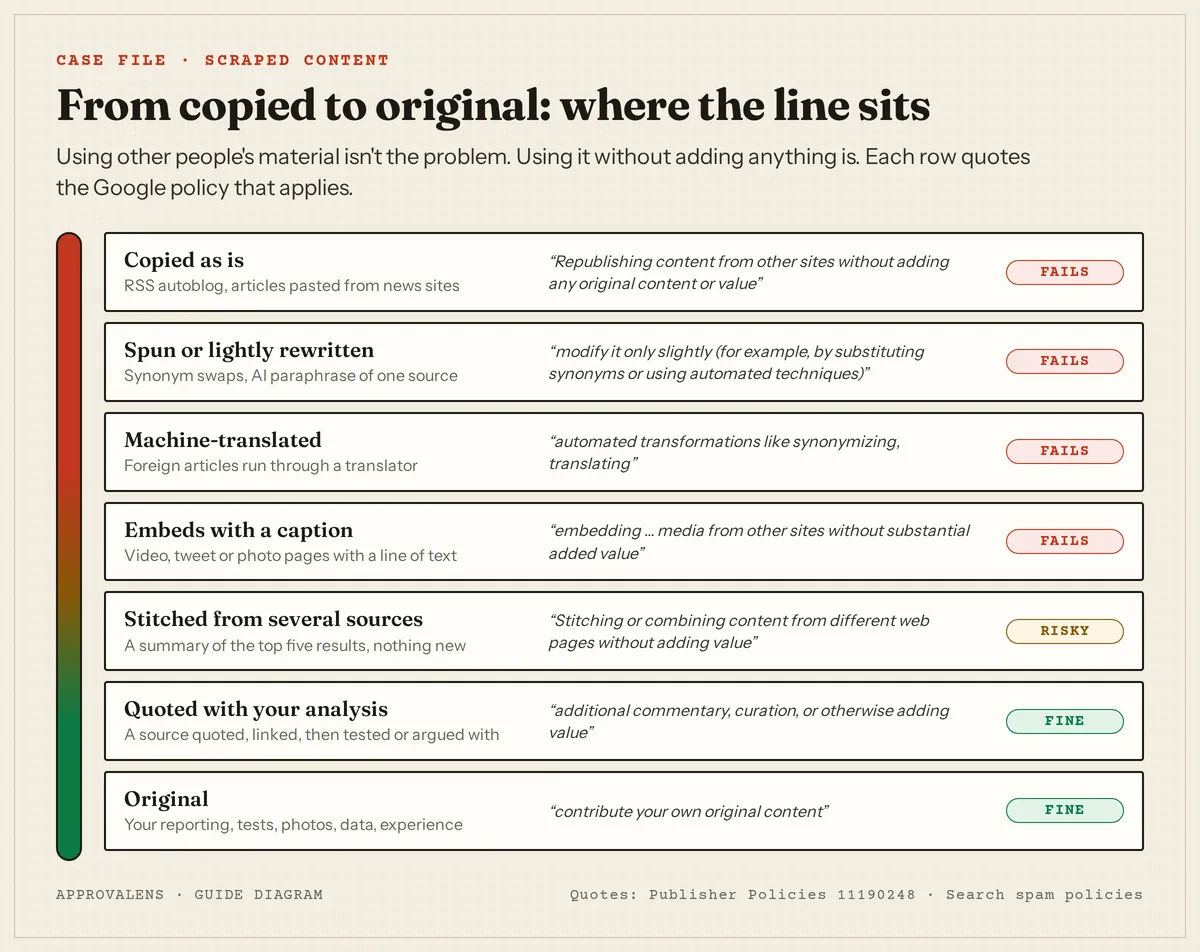
A quick way to place a page on that scale: delete every sentence that came from somewhere else, then read what's left. If what's left is a heading and a "source" link, the page is scraped. If what's left is your test, your numbers, your argument or your photos, the borrowed material is supporting your work, which is what the policy allows.
Common ways sites end up here
| Pattern | Often caused by | What to do |
|---|---|---|
| RSS or "auto blog" imports | Plugins that pull full posts from other sites | Remove the plugin and every imported post |
| News rewrites | Rewriting agency or competitor stories with new wording | Report only what you can add to: local angle, your sources, analysis |
| AI paraphrases | Pasting a competitor's article into an AI tool "to make it unique" | Delete; write from your own notes and tests |
| Translations | Translating popular foreign articles | Delete, or license them and add substantial commentary |
| Embed pages | Video, TikTok or Instagram pages with a sentence underneath | Merge into fewer pages with real write-ups, or remove |
| Manufacturer text | Product descriptions copied from the brand's site | Write your own assessment; keep specs in a short table |
| Quote and lyrics collections | Pages of other people's words | Remove unless you add real commentary and have the rights |
Copying isn't only a quality problem. Google's Publisher Policies separately don't allow content that "infringes copyright" (Google Publisher Policies), and a site built on someone else's text can fail on both counts.
Check your own site
- Search for your own sentences. Pick a distinctive sentence from the middle of five random articles and search for it in Google with quote marks around it. If the same sentence appears on an older page elsewhere, find out why.
- Look at what's installed. Plugins named "auto post", "RSS import", "content spinner", "article rewriter" or "feed to post" are a red flag. So are scheduled imports in your CMS.
- Check your canonical tags. View the source of an article and look for
<link rel="canonical". If it points to another domain, your page is telling Google the original lives somewhere else, which is common with imported posts. - Count embed pages. Sort your posts by word count. Pages under 150 words that are mostly a video or a social embed belong in the "embeds with a caption" row.
- Read your news or "trending" section. If each post is a paraphrase of one article from a larger outlet, that section is the likely trigger.
- Compare what crawlers see. Some scraper setups show different text to bots; run the URL through the Googlebot access checker to confirm Google gets the same page as visitors.
Fix it
- Remove imported and translated posts. Delete them rather than hiding them; return 410 or 404, or redirect to a related original page if you have one. Uninstall the import plugin so it can't refill the site.
- Rewrite borrowed posts you want to keep, from scratch. Start from your own notes, tests or reporting, not from the source text. Link the source for any fact you took from it. If you can't add anything, the post goes.
- Turn embed pages into real pages. Group videos by topic into one guide that explains each one, or write a proper review of the video's subject. A single video with a substantial write-up is fine; a hundred videos with a sentence each isn't.
- Replace manufacturer text with what you know from using the product. Keep a short spec table if it helps; it's the opinion that's yours.
- Fix internal duplication too. If your own posts copy each other (the same intro on every page, near-identical city or product pages), merge them. The duplicate content guide explains what counts.
- Look at the whole site again. After removals, is there still enough original content to review? If not, keep writing before you resubmit, or you'll trade this label for no content or low value content.
When other sites copied you
It happens: your original articles appear on scraper sites, sometimes ranking above you. That isn't scraping on your part, but nobody outside can see who published first. Make your originality easy to see:
- Show a visible publish date and author on every article, and keep them honest.
- Use your own photos and screenshots, which scrapers often strip or can't reproduce.
- Link between your own related articles so your site reads as the source of the topic.
- If copies rank in Google, you can report them to Google for legal reasons (a copyright complaint), which is a separate process from AdSense.
Request a review
When the copied material is gone and the remaining pages stand on their own, request a review from the Sites page in AdSense. Google says the review "usually takes a few days, but in some cases can take 2-4 weeks" (Site not ready to show ads). If an import plugin was the cause, check a week later that it hasn't been reinstalled by an update or a teammate.
Spot borrowed and repeated text before Google does
A free Approvalens scan flags posts that look imported from other sites, near-duplicate articles, sentences repeated across many pages, embed-only posts and canonicals that point to another domain. Find the borrowed pages on your site.
FAQ
Can I quote other websites at all?
Yes. Google's own wording allows content with "additional commentary, curation, or otherwise adding value". Quote what you need, link the source, and make your own contribution the main part of the page.
Is translating an English article into my language allowed?
Not as your own content. Google's spam policies name translating as one of the "automated transformations" used to disguise scraped content. With the author's permission and substantial added commentary, a translation can be part of a page; on its own it isn't original.
I used AI to rewrite articles from other sites. Is that scraping?
Yes, in Google's terms. Pages that "copy content from other sites, modify it slightly (for example, by substituting synonyms or using automated techniques), and republish it" are listed as replicated content, whatever tool did the rewriting. See AI content and AdSense for uses that are fine.
Do I need to delete the posts, or is noindex enough?
Delete copied posts. noindex keeps them out of Google Search, but visitors and reviewers can still reach them from your site, and copyright problems don't go away because a page isn't indexed.
Spotted something out of date or wrong? Tell us and we'll correct it.
Read this guide in Turkish →Check it on your own site. Free, no sign-up.
Free tools for this
Free scan
Check your own site
Free scan: readiness score and every issue, usually in a few minutes.