Recipe sites are one of the most common kinds of site that run AdSense, and nothing in Google's policies treats food content as a problem. What gets recipe sites rejected is how easy recipes are to copy. Ingredient lists look the same everywhere, so it's tempting to collect them from cookbooks, other blogs or social media, change the wording and publish. Google's policies cover exactly that, whether or not the copying is legal.
Copyright vs. Google's replicated-content rule
These are two different questions, and recipe sites often mix them up.
Copyright. The US Copyright Office says "a mere listing of ingredients or contents, or a simple set of directions, is uncopyrightable", but "a recipe that creatively explains or depicts how or why to perform a particular activity may be copyrightable" (Circular 33). Photos and the writing around a recipe are protected. Copying someone's photo or method text is an infringement problem, and Google doesn't allow ads on content that "infringes copyright" (intellectual property abuse).
Replicated content. Google's publisher policy goes further than copyright. It bars ads on screens "with embedded or copied content from others without additional commentary, curation, or otherwise adding value", including "rewriting of content from other sources without adding value" (replicated content). An ingredient list may be free to copy, but a site built from collected and reworded recipes is still a replicated-content site.
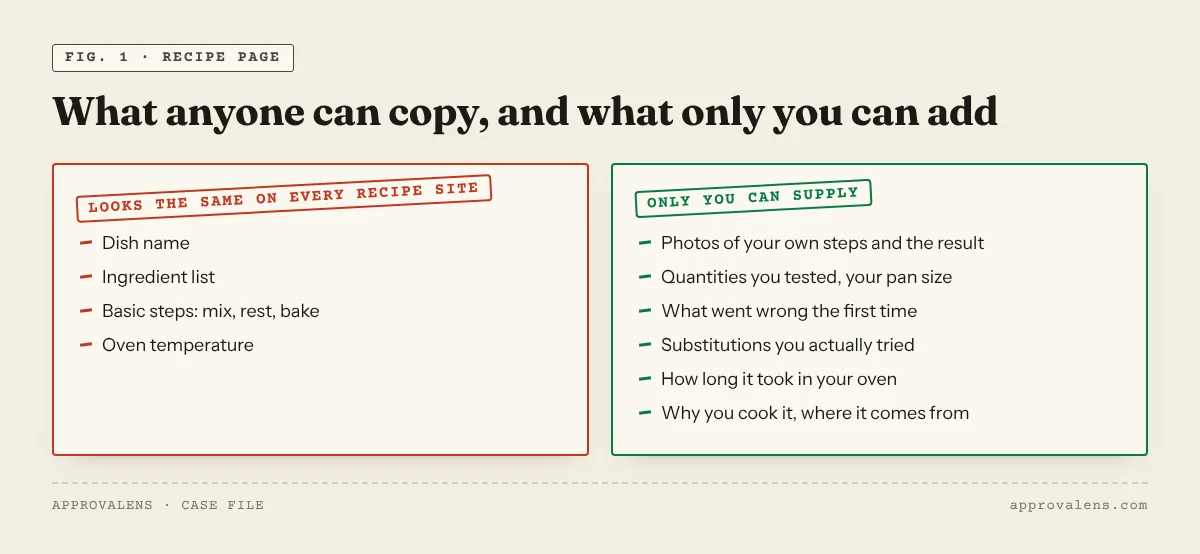
What makes a recipe page yours
Google's helpful-content guidance asks whether content shows "first-hand expertise and a depth of knowledge (for example, expertise that comes from having actually used a product or service…)" (helpful content). For recipes, that means:
- You cooked it. Say so, and show it: quantities you actually used, the pan size, the oven you have, how long it really took.
- Your own photos. Finished dish and the steps that matter. Stock photos and images pulled from other sites add nothing, and others' photos are not yours to use.
- What went wrong. Over-proofed dough, a sauce that split, what you changed the second time. Nobody else can copy this.
- Substitutions and variations. What works without eggs, at altitude, in an air fryer, and what you tested versus what you're guessing.
- Context. Where the dish comes from, when you make it, what to serve it with.
A page with these sections is long enough for a reviewer to judge without any word-count target.
Recipe structured data is optional
Recipe markup helps Google show rich results, but AdSense doesn't require it. Google's Recipe documentation lists only two required properties, image and name, with recommended ones like recipeIngredient, recipeInstructions, totalTime and recipeYield (Recipe structured data). If markup doesn't follow the guidelines, the recipe "might not show up as a rich result, but your content will still appear in Search results". Use it to describe the recipe on the page accurately, and don't mark up things that aren't recipes. Google's own example: "facial scrub" or "party ideas" are not valid names for a dish.
Ad layout on long recipe pages
Recipe pages are long, and it's tempting to put an ad after every paragraph. Google's policy on ad volume says publisher content doesn't include "whitespace, header or footer content, or links to other content on the site" (more ads than content), so a page where ads outweigh the recipe is a policy problem, not just bad taste.
Two recipe-specific traps:
- Jump-to-recipe and print buttons. Google warns that buttons and navigation near ads "might lead to accidental clicks" (placement policies). Keep ad units away from them.
- Ads in the ingredient list or between steps. Readers scroll there with greasy fingers. An ad between "add the flour" and "fold gently" is exactly where accidental taps happen.
Before approval you don't place ads at all. Just make sure the layout leaves room for them without burying the recipe.
Health claims
Food blogs drift into health: detox plans, "anti-cancer" smoothies, diabetic swaps. Google doesn't allow ads on content that "promotes harmful health claims, or relates to a current, major health crisis and contradicts authoritative scientific consensus" (unreliable and harmful claims). Health and nutrition are also "Your Money or Your Life" topics in Google's quality guidelines, where expertise counts for more (page quality explained). Describe food, not cures. If you publish nutrition advice, say who wrote it and what it's based on.
Feeds, embeds and AI recipes
- Imported posts. Plugins that pull recipes from other sites' RSS feeds create replicated content by definition. Google's spam policies name "reproducing content feeds from other sites without providing some type of unique benefit" (spam policies).
- Video-only posts. A post that is just an embedded cooking video adds little. The replicated-content policy lists "sites dedicated to embedding content such as video, images, or other media from other sites without substantial added value".
- Mass-generated recipes. Hundreds of AI-written recipes nobody cooked fall under "automatically generated content without manual review or curation" in the same policy. Our AI content guide covers where the line is.
Recipe site checklist
- Recipes you've cooked, written in your own words
- Your own photos, at least of the finished dish
- Notes only you could write: tested quantities, timings, mistakes, substitutions
- No recipes copied or reworded from books, sites or social media
- No auto-imported feeds or video-only posts
- Recipe markup, if used, matches what's on the page
- No health claims you can't back up
- Clear categories (courses, cuisines, diets) and an about page that says who cooks
- A privacy policy that covers Google's ad cookies (check it)
Check your recipe site
The free Approvalens scan compares your recipes against each other to find near-duplicates, flags imported feed content and stock photos, checks recipe markup and tells you whether a crawler sees your pages the way readers do. If your blog runs on Blogger, the Blogger guide covers the platform side.
FAQ
Can I publish my grandmother's recipe that's also in a cookbook?
The ingredient list itself isn't protected by copyright, but the cookbook's wording and photos are. Write it in your own words, with your own photos and notes on how your family makes it. That also makes it original under Google's policy.
Is translating recipes from foreign sites allowed?
Translation alone doesn't add value. Google's spam policies list "translating" among the "automated transformations" used for scaled content abuse. Cook the dish, adapt it to local ingredients, and write about that.
How many recipes do I need before applying?
Google doesn't publish a number. A reviewer needs enough original recipes to see what the site is about. See how many posts you need.
Spotted something out of date or wrong? Tell us and we'll correct it.
Read this guide in Turkish →Check it on your own site. Free, no sign-up.
Free tools for this
- /tools/googlebot-access-checkerGooglebot Access CheckerLoads your home page as Googlebot and the AdSense crawler and compares what each one gets.Open the tool
- /tools/privacy-policy-checkerPrivacy Policy CheckerChecks that your privacy policy covers what AdSense requires about Google's cookies.Open the tool
Free scan
Check your own site
Free scan: readiness score and every issue, usually in a few minutes.