Google doesn't allow ads next to content that infringes copyright, and it doesn't matter whether you host the file, embed it or link to it in a way that makes your page a gateway to it. On small sites the usual suspects are six: copied articles, pictures saved from image search, full song lyrics, film or APK downloads, embedded streams, and PDF books. The fix is to remove or replace it everywhere on the site, not just on the page Google mentioned, and then request a review.
The policy, in Google's words
The rule sits in the content policies of the Google Publisher Policies, under Intellectual property abuse (Intellectual property abuse). Google doesn't allow content that:
"infringes copyright. It is our policy to respond to notices of alleged infringement that comply with the Digital Millennium Copyright Act (DMCA). You can file a counter-notification via this form."
AdSense's own list of the top reasons accounts are closed spells out what counts (Top invalid traffic and policy violations):
"Google ads may not be displayed on sites or apps with content that infringes copyright. Some examples of copyrighted content might include audio and video files, television shows, software, comics, and literary works. When a site displays someone else's site within a frame or window on their own site, this is considered framing content. Placing Google ads on such pages is strictly prohibited."
Two neighbouring policies catch the same sites from a different angle. Replicated content bans ads on screens "with embedded or copied content from others without additional commentary, curation, or otherwise adding value to that content" (replicated content). Enabling dishonest behavior covers "products or services that bypass copyright protection" and "pages that assist or enable users to download streaming videos if prohibited by the content provider" (Google Publisher Policies). That last line is the one video downloader sites run into.
How it reaches you
You'll usually meet it in one of these forms:
- A rejection during the site review, under "Policy violations". The policy violations rejection guide covers that route and what else gets checked.
- A Policy center issue on an approved site, sometimes page-level, sometimes for the whole site.
- A copyright removal notice against your URLs in Google Search. Rights holders file these with Google, and Google says it will notify site owners who "have registered with our Search Console as website owners" (copyright removals FAQ). This isn't an AdSense action by itself, but it tells you exactly which pages someone has complained about.
What Lumen is and why your URL is on it
Google sends copies of many legal removal notices to Lumen, "an independent research project managed by the Berkman Klein Center for Internet & Society at Harvard Law School" (About Lumen). For copyright notices Google generally shares the requester's name, the rights holder, "The reported URLs", the date and "A quote of the alleged infringing content", but never the requester's e-mail address. When a search result is removed, "a notice may appear at the bottom of that page" linking to the Lumen copy.
So if you find your domain on Lumen, you're reading the actual complaint: who sent it, which URLs, and what they say you copied. That's the best to-do list you'll get. You can also look your domain up in Google's Transparency Report (swap example.com for your domain) to see how many URLs have been reported.
It matters for Search too. Google's spam policies say that "When we receive a significant volume of valid copyright removal requests involving a given site, we are able to use that to demote other content from the site in our results" (spam policies: legal removals).
Where it hides on small sites
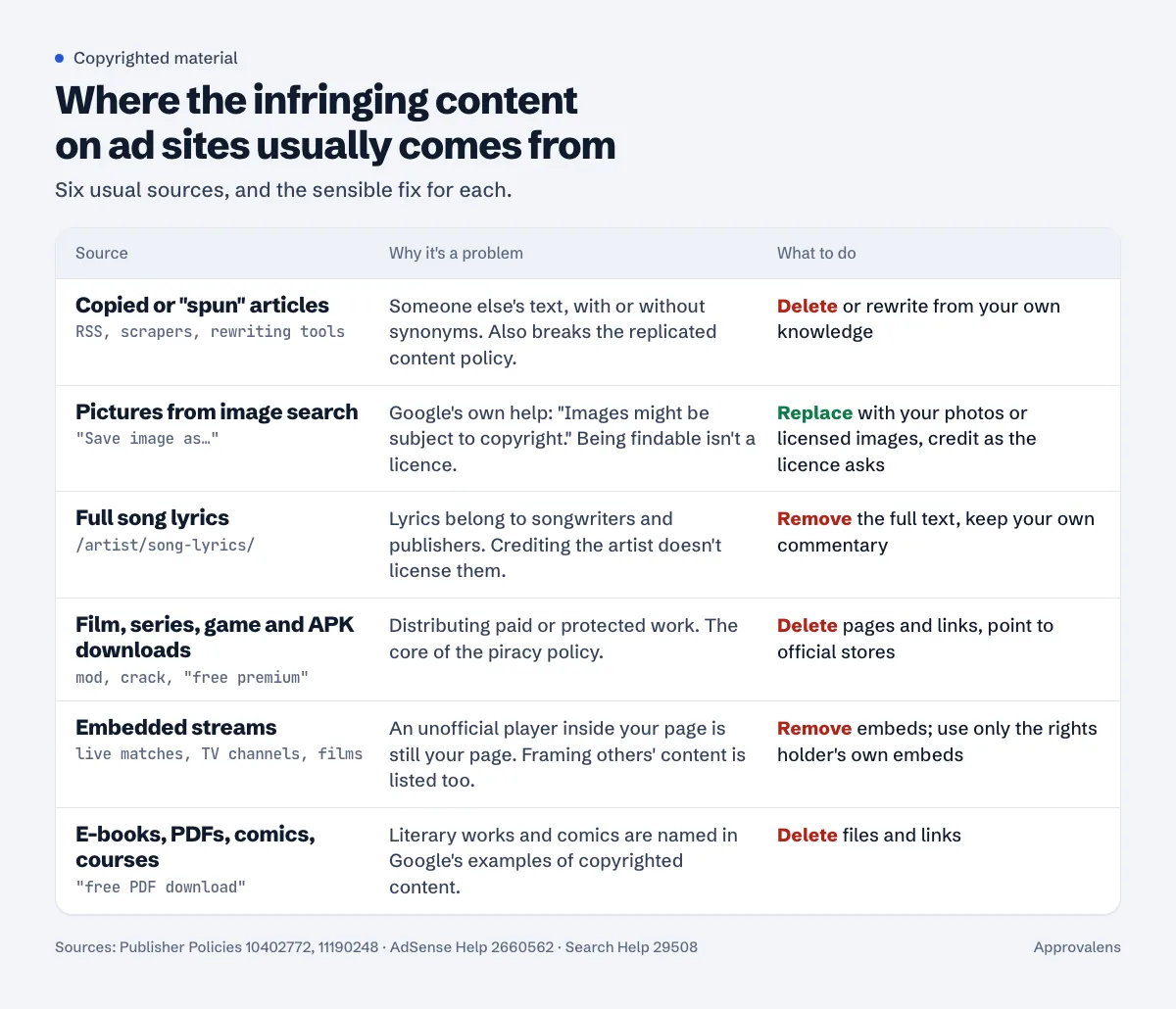
Copied and "spun" articles. Auto-imported RSS posts, scraped news, and articles run through a rewriting tool. The replicated content policy names "Sites that copy content from other sites, modify it slightly (for example, by substituting synonyms or using automated techniques), and republish it". If that's your site, read the scraped content guide as well.
Images from image search. Google's own help page is plain about it: "Images might be subject to copyright." (Find images you can use & share). The "Usage rights" filter helps, but Google adds that it filters "based on information provided by the sites that host those images" and tells you to "Always confirm an image's license information." Product photos, celebrity photos and stock images with the watermark cropped out are the usual problems.
Song lyrics. Crediting the artist doesn't license the words. The lyrics sites guide goes through what can work instead.
Film, series, game, software and APK downloads. Including "mod", "crack", "free premium" and links that just point to a file host. The APK sites guide covers what an acceptable app site looks like.
Embedded streams. A live match or TV channel in an iframe from an unofficial source is still on your page, and framing someone else's site is named directly in the closure reasons. Official embeds from the rights holder (a film studio's own trailer on its YouTube channel, for example) are a different case; the replicated content policy still wants your own text around them.
E-books, PDFs, comics, course videos. "Free PDF download" pages for books still in print are a fast way to an IP issue. Literary works and comics are in Google's example list.
Wallpaper and image gallery sites sit across several of these at once; the wallpaper sites guide is worth a read if that's you.
Find it on your own site
Google's notices give examples, not a full list. Do a pass over the whole site:
- Check the complaint first. Search Console messages, the Lumen notice, the Policy center issue details. Note every URL and what was claimed.
- Search your content for risky words. In WordPress, a quick SQL query or the admin search works. From a terminal, against an export or the live sitemap:
# Pages whose text mentions typical piracy terms
for u in $(curl -s https://example.com/sitemap.xml | grep -o '<loc>[^<]*' | sed 's/<loc>//'); do
  curl -s "$u" | grep -qiE 'mod apk|crack|keygen|full movie|watch free|free pdf|lyrics' && echo "$u"
done
- List every iframe source. Anything that isn't YouTube, Vimeo or another platform where the uploader is the rights holder deserves a look:
curl -s https://example.com/some-post/ | grep -oiE '<iframe[^>]+src="[^"]+"' | sed 's/.*src="//'
- Check where your images came from. Open the media library sorted by date and look at the oldest uploads first. Run a few through a reverse image search; if the same photo shows up on a stock agency's site, replace it.
- Copy a distinctive sentence from a few of your oldest posts and search it in quotes. If another site published it first, you have a copied article.
Fix it, in this order
- Delete pages that only exist to distribute someone else's work. Download pages, stream pages, PDF pages, full lyrics. Return a
404or410for them, and remove internal links and menu entries pointing to them. - Replace images with your own photos or images whose licence allows commercial use, and credit them the way the licence asks.
- Rewrite or remove copied articles. A credit line ("Source: ...") doesn't give you the right to republish. Disclaimers such as "no copyright infringement intended" don't either.
- Remove unofficial embeds. Keep only embeds from the rights holder's own channel, with your own text around them.
- Check the whole site again with the steps above. The same template, plugin or habit usually produced many pages, not one.
Short quotes inside your own review or commentary are a different situation from republishing. Where the legal line sits depends on the law that applies to you; it's a question for a lawyer, and Google's help pages don't draw it for you.
If you think the claim is wrong
Not every notice is valid. Google's own FAQ lists invalid requests it received and refused, and says it may decline URLs where the request "clearly did not infringe copyrights" (copyright removals FAQ).
For a Search removal you can file a counter notice, via the form linked from the IP abuse policy. Read Google's warning first: "filing a counter notice may lead the complainant to initiate legal proceedings against you". If the complainant doesn't start legal proceedings "within 10 business days", Google restores the content when it doesn't break any other policy (How to resolve complaints of copyright infringement). The same page notes that many people first contact the complainant and ask for a retraction.
Only do this when you own the work or have a licence you can show.
Request the review
For a Policy center issue: Policy center > Fix > Start review process, then "Fixed the violations" (Fix policy issues that affect ad serving). If it was an application rejection, fix everything first and then request a review from Sites. Either way, Google's FAQ warns that the URL in its notice "is just an example and the same violations may exist on other pages of this site" (AdSense policy FAQs), so a review after fixing only the example page tends to come back rejected.
Find the risky pages before a reviewer does
A free Approvalens scan flags pages that mention cracks, mod APKs, torrents or free full movies, and articles that are mostly embeds: scan your site.
FAQ
Can I use images if I credit the photographer?
Only if the licence allows it. Credit is often a condition of a licence, not a replacement for one. Use your own photos or images with a licence that permits commercial use.
Is linking to a download on another site safe?
No. Google's copyright removal process covers pages that link to allegedly infringing material, and the AdSense closure reasons are about the content your page offers, wherever the file sits.
My site embeds YouTube videos. Is that a copyright violation?
Embedding a video the rights holder published on their own channel isn't the problem. A page that's only an embed, with nothing of yours around it, runs into the replicated content policy instead.
Will one DMCA notice close my AdSense account?
Google doesn't publish a threshold. A notice tells you which pages someone complained about; fix them quickly, and check the rest of the site for the same pattern.
How do I see the DMCA complaints filed against my site?
Check Search Console messages, search for your domain on Lumen, and look it up in Google's Transparency Report copyright section.
Spotted something out of date or wrong? Tell us and we'll correct it.
Read this guide in Turkish →Free scan
Check your own site
The free scan reads the first 50 pages and shows your score and every problem it finds.