On this page (9)
Wallpaper sites are built from images, and AdSense is built on text. That mismatch, more than any rule about wallpapers, is why so many wallpaper sites are turned down. No Google policy names wallpaper sites, and Google publishes no rejection figures for them. But three written rules hit a typical wallpaper site on almost every page: too little text, images that belong to someone else, and download buttons right next to where the ads would go.
Problem 1: pages that are only pictures
AdSense says plainly: "Make sure that your pages have sufficient text - sites that contain mostly images, videos or Flash animations may not be approved", and "Your content should contain complete sentences and paragraphs, not only headlines" (account not approved). It also explains why text matters for ads: "AdSense works by crawling your web pages for content … if your content is limited, our crawler may have difficulty identifying the information on the page" (content for targeting).
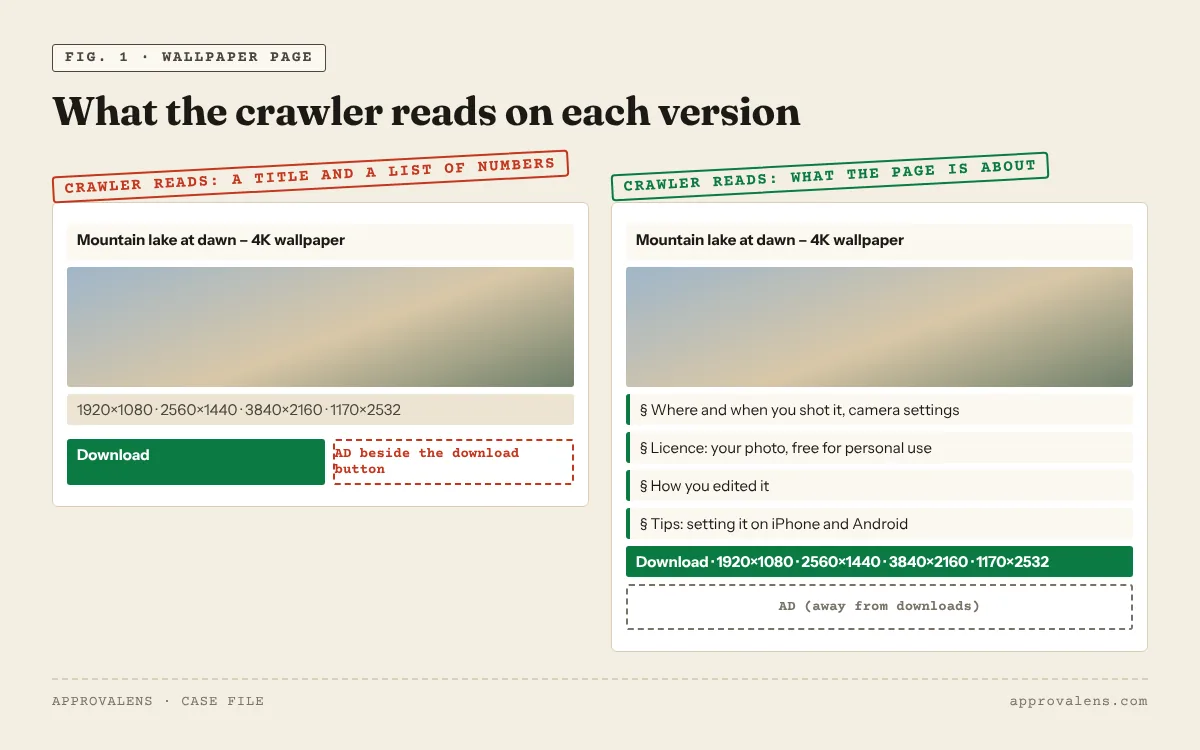
A wallpaper page with a title, an image, a resolution list and a download button gives the crawler a title and a few numbers.
Problem 2: whose images are they?
Most wallpaper collections are gathered from search engines, Pinterest, fan sites or other wallpaper sites. Film stills, anime and game art, sports club crests, car brand photography and celebrity photos all belong to someone.
- Google doesn't allow ads on content that "infringes copyright" (intellectual property abuse), and AdSense says ads "may not be placed on sites with scraped or copyrighted content" (site pages ready).
- Even freely licensed images run into the replicated-content policy, which names "sites dedicated to embedding content such as video, images, or other media from other sites without substantial added value to the user" (replicated content). Re-hosting photos from a free stock site doesn't give a reviewer anything they couldn't get at the source.
Problem 3: suggestive images
Wallpaper sites often drift into "hot", "sexy" or anime fan-service categories. Google treats "sexually suggestive" content as a restriction (fewer ads), with examples like "close-ups of breasts, buttocks, or crotches, sheer or see-through clothing" (sexual content). Explicit content is a violation (sexually explicit content). And publisher policies separately bar content that "is made to appear appropriate for a family audience, but contains adult themes" (publisher policies). A cartoon-style category with adult images fits that description.
Problem 4: download buttons and galleries next to ads
Wallpaper pages are full of things people click: thumbnails, next/previous arrows, resolution buttons, download links. Google's placement rules:
- "Be careful when placing links, play buttons, download buttons, navigation buttons (e.g., "Previous" or "Next") … near ads because they might lead to accidental clicks" (placement policies).
- Ads must not be "mistaken for other site content, such as a menu, navigation, or download links".
- Publishers "may not display the ads for a preset time (i.e., pre-roll) before users can view content such as … downloads". A countdown before the download starts, with an ad on screen, is that.
- Google's policy on ads interfering with the site lists "an image in an image gallery" among the elements that ads must not overlay or crowd (interfering ads).
Paid link shorteners in front of downloads ("wait 5 seconds, click skip") are a separate red flag. Approvalens checks for them.
Problem 5: a page for every image and every size
Wallpaper scripts tend to create one page per image, per resolution, per device, plus tag pages for every colour and keyword. Thousands of pages that differ by a number in the title are the thin variants that Google's spam policies call scaled content. Keep one page per image with all sizes on it, and only keep tag pages you'd curate by hand.
What a wallpaper site would need
| Instead of | Publish |
|---|---|
| Images collected from other sites | Your own photography, art or renders, or images you have written permission to use |
| A title and a download button | A description: what it shows, where and how it was made, the licence, editing notes |
| Re-hosted free stock photos | Curated collections with commentary on why each image is there |
| A page per resolution | One page per image, all sizes listed |
| Gallery only | Guides people search for: setting a wallpaper on each phone, resolutions and aspect ratios explained, how to make your own |
If you make the images yourself, including AI-generated art, they're original. They still need text around them. And hundreds of generated images published without review fall under the "automatically generated content without manual review or curation" example in the replicated-content policy.
Wallpaper site checklist
- Every image is yours, licensed to you, or used with written permission
- Every image page has real sentences about the image, not just a title
- Guides or articles that stand on their own
- No suggestive categories, especially in "family-looking" styles
- Ads planned away from thumbnails, arrows and download buttons
- No countdowns or link shorteners before downloads
- One page per image, not per resolution
- Image alt text that describes the picture
Check your site
The free Approvalens scan measures how much text each page has, finds near-identical gallery templates and resolution variants, flags download shorteners and checks image alt text. It tells you what a crawler sees on a page you think of as "full".
FAQ
Can an image-only site ever get AdSense?
Google says sites that are mostly images "may not be approved". That isn't an absolute ban, but you'd be relying on the exception. Adding real text is the dependable route.
Are free stock images OK?
Legally, if the licence allows it. For AdSense, a site that only re-hosts free stock images adds nothing new, which is what the replicated-content policy is about.
Do AI-generated wallpapers count as original?
If you made them, they aren't copied from anyone. They still need descriptions and context, and mass-publishing them without review is the "automatically generated" pattern Google warns about.
Spotted something out of date or wrong? Tell us and we'll correct it.
Read this guide in Turkish →Check it on your own site. Free, no sign-up.
Free tools for this
Free scan
Check your own site
Free scan: readiness score and every issue, usually in a few minutes.