News is a normal AdSense niche. Plenty of publishers monetise it, and no policy treats news as low value. The trouble is the way many small news sites are built: a news script that pulls stories from agencies or other sites' feeds, publishes them unchanged, and adds a tag page for every name in the story. That produces hundreds of pages a reviewer has seen elsewhere, under a brand that doesn't say who runs it. This guide covers what Google's policies say about each of those habits.
AdSense and Google News are separate
Getting into Google News isn't an application, and it isn't a precondition for AdSense. "Google automatically considers all web content for inclusion in Google News, so you don't need to apply" (Google News). AdSense is reviewed separately. But Google News's transparency rules are a useful checklist for AdSense too, because they describe what a trustworthy news site shows. News sources should provide "clear dates and bylines; information about the authors, publication, and publisher; information about the company or network behind the content; contact information" (Google News policies).
The biggest risk: other people's stories
Google's replicated-content policy has a sentence written for news sites: "Publishers who publish articles from other sources, and publish them as their own are in violation of this policy" (replicated content). The same policy bars ads on content "copied from others without additional commentary, curation, or otherwise adding value".
Three common setups fall under it:
| Setup | Why it's a problem | What changes it |
|---|---|---|
| Scraped RSS feeds from other news sites | Google's spam policies name "reproducing content feeds from other sites without providing some type of unique benefit to the user" (spam policies) | Turn off auto-import. Write your own reports |
| Rewritten articles: someone else's story with the sentences shuffled | "Sites that copy content from other sites, modify it slightly … and republish it" is a listed example of replicated content | Report it yourself, or link to the source and add analysis |
| Licensed agency copy published unchanged | A subscription makes it legal, but the same text runs on every subscriber's site. Legal isn't the same as original | Use agency copy as raw material: add local angles, quotes, photos, context and follow-ups |
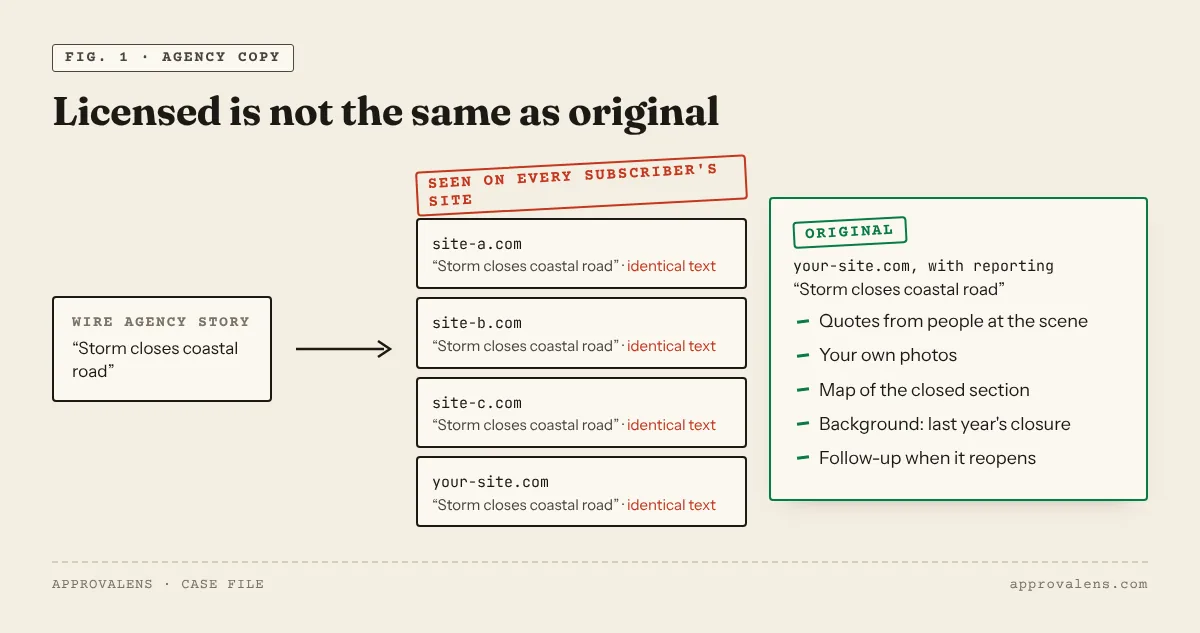
None of this means a news site can't use agency material. It means agency copy can't be the whole site. A reviewer should find stories, photos and explanations that exist only on your site.
Show who you are
Ownership matters more for news than for most niches. Google's misrepresentation policy bars content that "misrepresents, misstates, or conceals information about the publisher, the content creator, the purpose of the content, or the content itself" (misrepresentation). For political and social topics, Google's publisher policies also prohibit "concealing or misrepresenting your identity or other material details about yourself" (publisher policies).
On the site, that means:
- Bylines on every article, linked to author pages with real names and roles (author pages guide).
- Dates that mean something. Published and updated dates, where "updated" changes only when the story does. Bumping dates to look fresh misleads readers, and Approvalens flags dates that change while the content doesn't.
- An about page naming the publisher: the company or person behind the site, editorial contacts, a correction policy.
- A real contact route, not only a form (about and contact guide).
Policies that hit news content specifically
- Unreliable and harmful claims. No ads on content that "makes claims that are demonstrably false and could significantly undermine participation or trust in an electoral or democratic process", that "promotes harmful health claims", or that "contradicts authoritative scientific consensus on climate change" (unreliable claims).
- Sensitive events. During an unforeseen event that "creates significant risk to Google's ability to provide high quality, relevant information", Google "may take a variety of actions" (program policies). Expect ad limits on coverage of disasters and attacks.
- Shocking content. Graphic accident, crime or war images, and "obscene or profane language", are publisher restrictions: the page can still carry ads, but fewer (publisher restrictions). Blur or leave out graphic photos and keep them off the home page.
- Misleading headlines. Google News doesn't allow "preview content that misleads users to engage with it by promising details which aren't reflected in the underlying content". A headline that promises a revelation the article doesn't contain fails that test, and Approvalens flags clickbait and all-caps titles.
- Advertising volume. Google News: "Advertising and other paid promotional material on your pages shouldn't exceed your content", and sponsored content must not be passed off as editorial.
Tags, archives and other news-script leftovers
News scripts generate a tag page for every person, place and team mentioned. Most of those pages list one or two stories. Together with date archives, author archives and AMP or print duplicates, they can outnumber your articles several times over. That's the kind of thin, auto-generated listing a reviewer sees as low value. Keep tags you curate, set the rest to noindex, and keep them out of the sitemap.
News site checklist
- No auto-imported RSS feeds. Every published story has an editor
- Agency copy, if used, has your own reporting, context or local angle added
- No rewritten copies of other outlets' stories
- Bylines and author pages on every article
- Honest published and updated dates
- About page names the publisher. Contact details and corrections policy are easy to find
- Headlines match what the article delivers
- Graphic images blurred or removed
- Thin tag and archive pages noindexed and out of the sitemap
- A privacy policy that covers Google's ad cookies (check it)
Scan your news site
The free Approvalens scan spots feed-import traces ("The post … appeared first on …"), compares articles for near-duplicates, checks bylines, dates and ownership pages, flags clickbait titles and counts tag pages against real articles.
FAQ
Do I need to be in Google News to get AdSense?
No. They're separate. Google News inclusion is automatic and has its own policies. AdSense reviews your site on its own terms.
Is publishing agency news with a subscription allowed?
It's legal under your licence, but if the whole site is unchanged agency copy, there's nothing original for AdSense to approve. Add your own reporting and context.
How many articles does a news site need?
Google doesn't publish a number. A reviewer needs to see enough original reporting to judge the site. Volume of copied stories doesn't help. See how many posts you need.
Spotted something out of date or wrong? Tell us and we'll correct it.
Read this guide in Turkish →Check it on your own site. Free, no sign-up.
Free tools for this
- /tools/privacy-policy-checkerPrivacy Policy CheckerChecks that your privacy policy covers what AdSense requires about Google's cookies.Open the tool
- /tools/googlebot-access-checkerGooglebot Access CheckerLoads your home page as Googlebot and the AdSense crawler and compares what each one gets.Open the tool
Free scan
Check your own site
Free scan: readiness score and every issue, usually in a few minutes.