There's no word count for AdSense. Google's help asks for "sufficient text" and "complete sentences and paragraphs, not only headlines", and Google Search says plainly that it has no preferred word count. A post is long enough when it fully answers the question it's about, with what only you can add, and stops there. Very short pages (a heading, a video and two lines) rarely manage that; very long pages often fail too, when the length comes from repetition or templates. Below: what Google says, what real data shows, and a quick test for your own posts.
What Google says about length
- Under "Insufficient content", AdSense asks you to "Make sure that your pages have sufficient text - sites that contain mostly images, videos or Flash animations may not be approved" and says "Your content should contain complete sentences and paragraphs, not only headlines" (Your AdSense account wasn't approved).
- Google Search's helpful content guidance lists, among warning signs: "Are you writing to a particular word count because you've heard or read that Google has a preferred word count? (No, we don't.)"
- The same page asks: "Does the content provide a substantial, complete, or comprehensive description of the topic?" and, as a warning sign, "Does your content leave readers feeling like they need to search again to get better information from other sources?"
So the official bar is completeness, not length. The numbers you see in forums (300, 500, 1,000 words, or "at least 200 words per post" in Turkish forums) are rules of thumb people made up to approximate that bar.
The one number we use, and why it's not Google's
Approvalens flags an article as thin when it has less than 300 words of main text, not counting menus, sidebars and footers. That's our heuristic for "probably too short to be complete", not a Google threshold, and it's why the report says "Under 300 words usually reads as thin" rather than "Google requires 300 words".
Here's what that looks like on a real site. This is from an Approvalens scan of gunlukrituel.com.tr, a live Turkish site whose owner let us use the report:
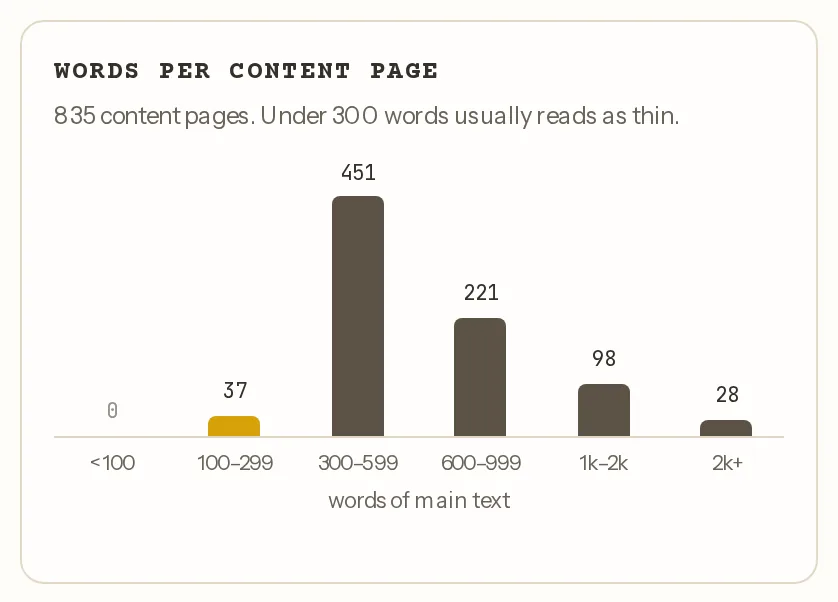
By word count alone, this site looks healthy. But sort the same site's pages by quality rating, lowest first:
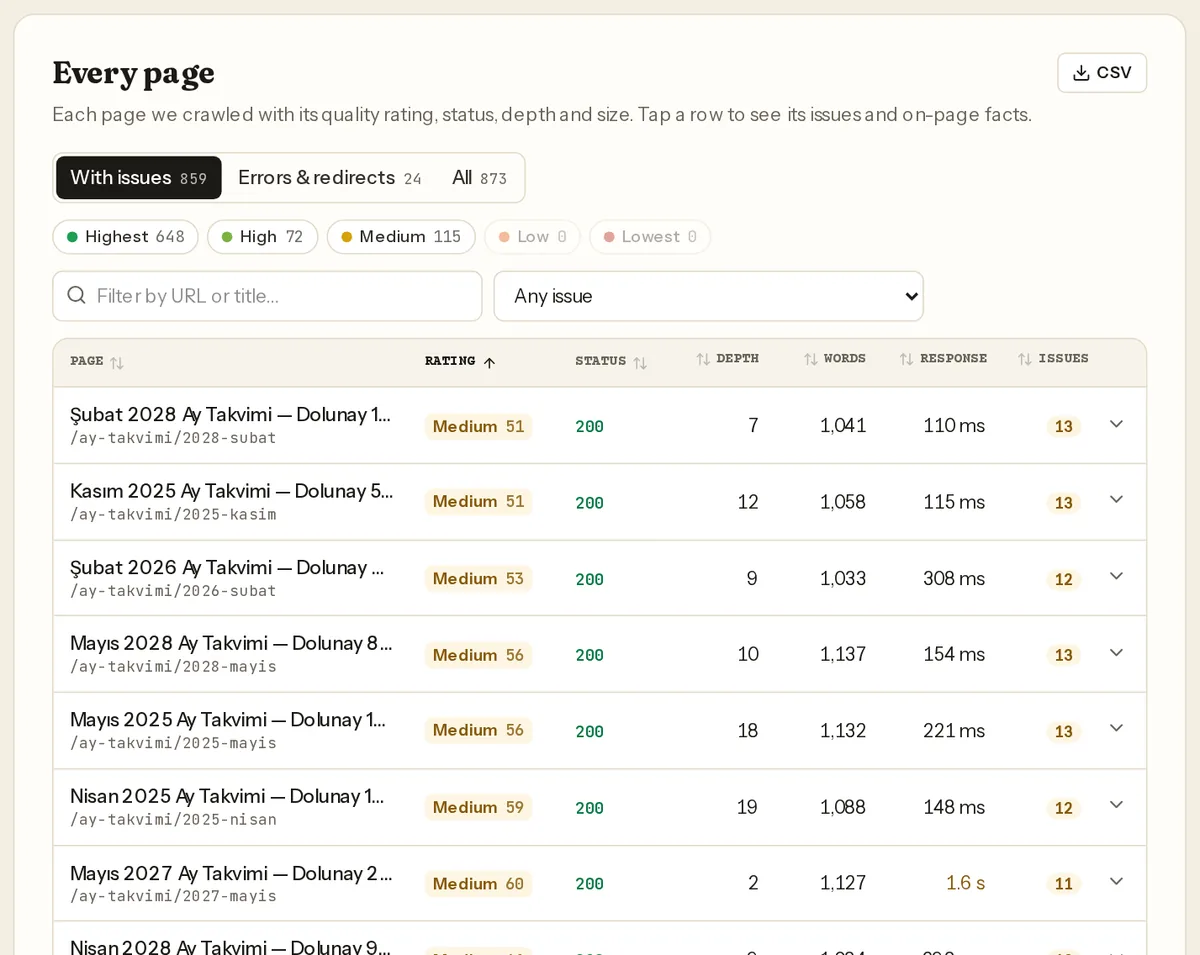
The lowest-rated pages aren't short. They're monthly calendar pages of 1,000 words or more, built from the same template, buried 7 to 19 clicks deep. Each one is long; together they're the pattern Google describes as low value content. Word count measured nothing useful here.
Length follows the question
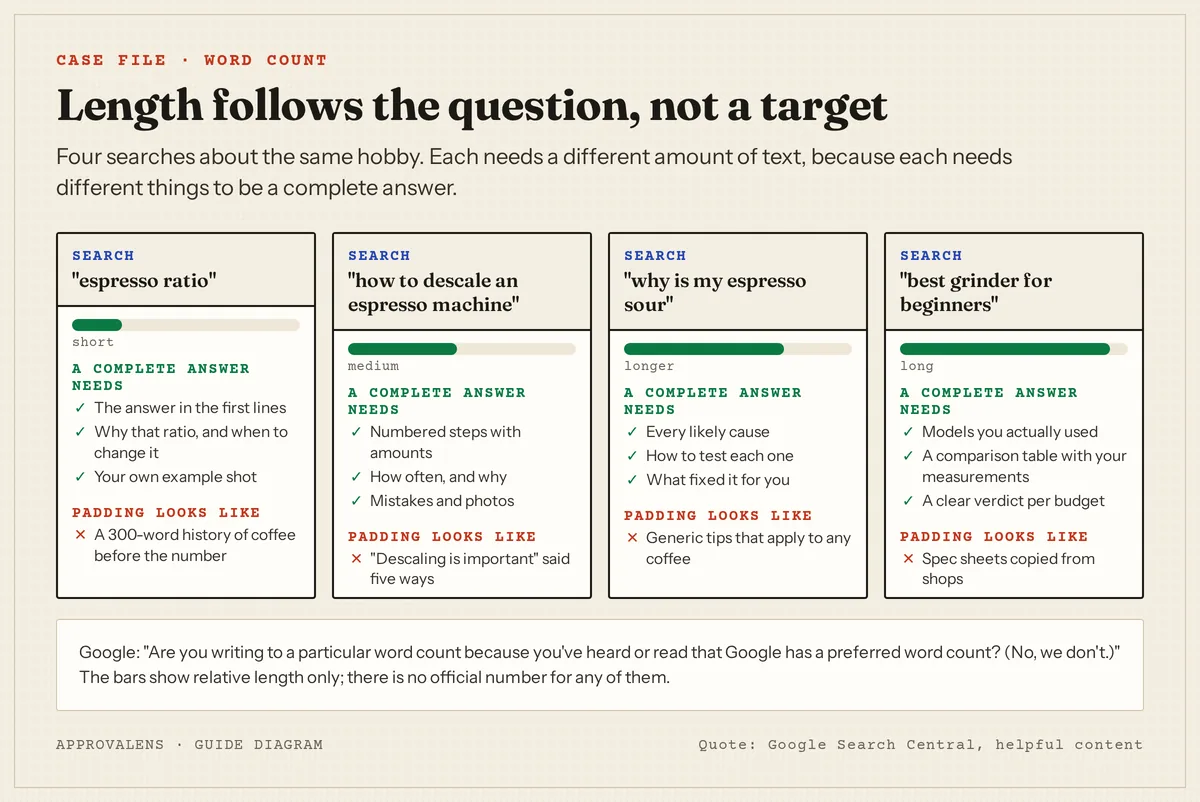
Write until the reader has what they came for, then stop. A practical way to plan:
- Write the question at the top of your draft. One sentence, the way a reader would type it.
- List what a complete answer must contain. Steps, causes, numbers, a comparison, a verdict, your own example. This list, not a word target, decides the length.
- Add what only you can add. Measurements, photos, mistakes, what worked for you. This is what AdSense means by "your own original content" (site readiness).
- Cut everything that doesn't serve the list. Generic introductions, the question restated as a paragraph, conclusions that repeat the headings.
How to tell complete from padded
Read a post and check each line:
| Sign of a complete page | Sign of padding |
|---|---|
| The answer appears early | Three paragraphs before the answer |
| Specific numbers, names, steps, photos | Sentences that would fit any article on any topic |
| Each heading adds something new | Headings that repeat the title in other words |
| Sources linked where facts come from elsewhere | Claims with no source, or invented statistics |
| Ends when the question is answered | A conclusion that summarises everything again |
| Text written for this page | The same paragraphs on many pages |
The last row matters most for AdSense, because repeated text across pages is how long sites end up rated low value. Approvalens checks for sentences repeated across many pages, generic filler phrases and keyword stuffing for exactly this reason.
Short pages and ads
Length matters in one more place: once you show ads. Google's Publisher Policies don't allow Google-served ads on screens "with more ads or other paid promotional material than publisher-content" (Google Publisher Policies). A 150-word page with three ad units is the kind of page that rule is about. Short pages can be fine; short pages packed with ads aren't.
Check your own posts
- Pick ten random articles, not your favourites.
- For each, write the question it answers in one line. If you can't, the page has no clear purpose.
- Read it on a phone. Note where you'd go back to the search results.
- Count the sentences you could delete without losing information. More than a few, and the page is padded.
- Check main-text length with the free Googlebot access checker, which also shows whether Google's crawlers receive the same words as visitors.
See your site's word counts and quality side by side
A free Approvalens scan shows the word distribution of every content page, rates each page against questions based on Google's quality guidance, and flags thin pages, templated pages and text repeated across the site. Compare length and quality on your site.
FAQ
Is 300 words enough for AdSense?
Sometimes. If 300 words answer the question completely, with something original, the page is fine. Most questions need more, but there's no number from Google either way.
Should I make every post 1,000+ words?
No. Length you add only to reach a number is the padding that makes pages read as low value. Some topics need 2,000 words; others are done in 500.
Do images and videos count toward length?
They add value, but they don't replace text. Google says sites "that contain mostly images, videos or Flash animations may not be approved". Write about what the image or video shows.
Does word count matter for the AdSense review at all?
Indirectly. Very short pages rarely contain a complete answer, so they often show up in "low value" and "no content" rejections. But it's the missing answer, not the number, that counts.
How many words should a page about a tool or calculator have?
Enough to explain what the tool does, how to use it, an example with real inputs and the limits of the result. See how many posts you need for how tool sites are judged.
Spotted something out of date or wrong? Tell us and we'll correct it.
Read this guide in Turkish →Check it on your own site. Free, no sign-up.
Free tools for this
Free scan
Check your own site
Free scan: readiness score and every issue, usually in a few minutes.